
Emotional Crypto Scam: How Fake Emergencies Work
- Cryptocurrency
- March 25, 2026
Table of Contents
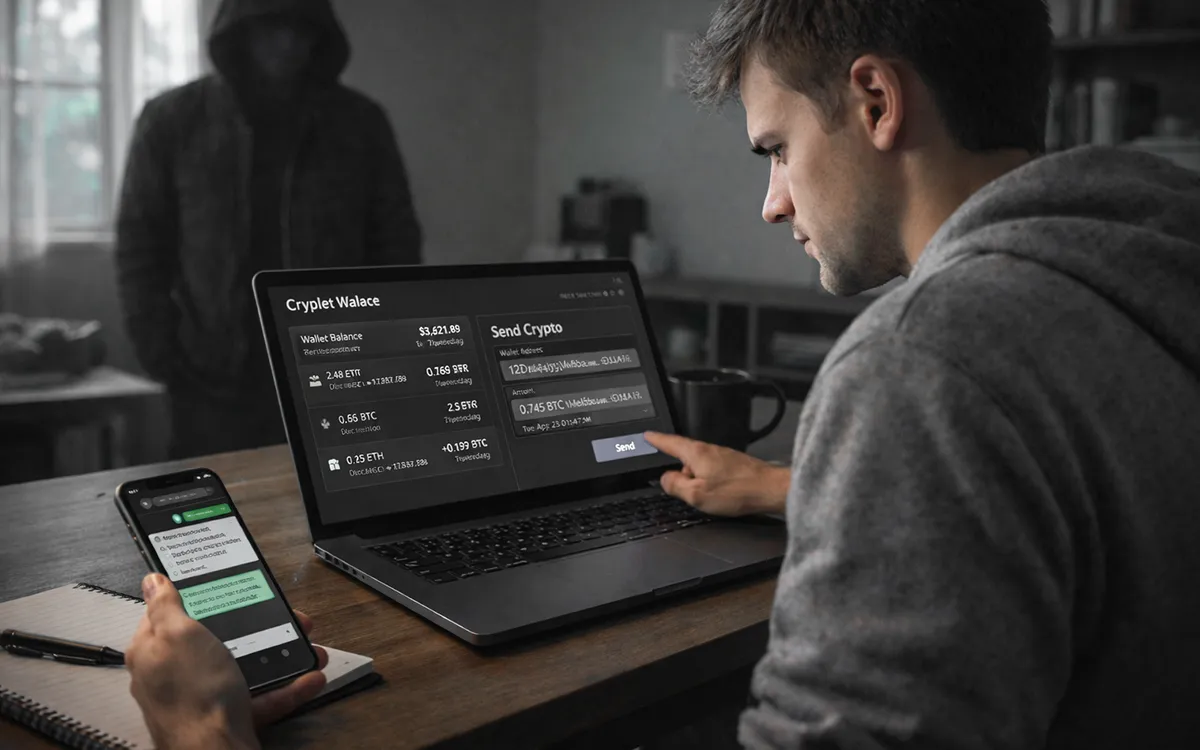
An emotional crypto scam is a type of scam where fraudsters exploit your emotions of compassion, sympathy, or empathy to defraud you into transferring cryptocurrency. The story may appear genuine, but it is designed to create urgency and push you to act without verifying the facts.
Such frauds tend to follow a general pattern. The trend is something emotionally provoked, like a health crisis, a separation, a charitable event, a catastrophe, or an acute personal crisis. Then comes the pressure. The scammer will ask for cryptocurrency to “help” or “solve” the situation. After the cryptocurrency is sent, the line goes dead, or the scammers simply vanish.
According to Chainalysis, cryptocurrency scams stole around $17 billion worldwide in 2025.
This works because your emotions can cloud your judgment. The scammers use your genuine empathy by saying something like “I have no one else,” “Please don’t tell anyone,” or “I just need help one last time.” The cryptocurrency is sent quickly, and once it’s sent, it’s irreversible.
Legitimate charities and organizations do not pressure people to send cryptocurrency urgently without verification. Be careful when an emotionally colored matter demands cryptocurrency.
Emotional crypto scams are becoming more common on social media, messaging apps, and dating platforms. Understanding how they work is the first step to protecting your cryptocurrency. These scams often begin on Instagram, WhatsApp, Telegram, Facebook, and dating apps.
What Is an Emotional or Compassion-Based Crypto Scam?
An emotional crypto scam is a type of cryptocurrency scam that is based on psychological manipulation instead of a hack into a system. Instead of hacking systems, scammers target emotions like fear, love, urgency, and guilt.
The fraud starts with an impressive story. The fake person can explain to you that there is an emergency need for cryptocurrency due to medical use, crisis relief, travel emergencies, frozen investment payments, or a love issue. The goal is to reduce your skepticism and act immediately.
You may wonder later, “Was this a genuine emergency?” or “Do genuine causes ask for cryptocurrency in this manner?” In an emotional scam, the payment is made to a personal wallet address, and there is no way to reverse the transaction.
Unlike phishing scams, which use a fake login page, emotional manipulation scams first establish trust and then use urgency and cryptocurrency as the only solution.
Why Emotional Manipulation Works So Well in Crypto Scams?
Emotionally driven crypto scams work well because intense emotions can overpower logical thinking. If any of the emotions, like fear, love, guilt, or urgency, are brought out, people will most probably act first and check later.
Scammers are aware of the fact that cryptocurrency transactions are quick and final. After a crypto transfer is made, the only way to get it back is through the sender's goodwill, which is very unlikely.
By creating urgent emotional situations, scammers reduce the chance that victims will pause and verify the story.
Many victims later say:
“I wasn’t thinking clearly.”
“I just wanted to help.”
This is not a coincidence. Emotional manipulation is a deliberate social engineering tactic. Scammers combine urgency (“I need help now”), isolation (“Don’t tell anyone”), and exclusivity (“Only you can help me”) to weaken logical decision-making.
Crypto makes this tactic more effective because:
Once cryptocurrency is sent, it cannot be reversed like a bank transfer or credit card payment.
When emotion replaces verification, financial risk increases. Understanding this psychological pattern makes it easier to recognize and stop an emotional crypto scam before funds are sent.
How Emotional Crypto Scams Work?
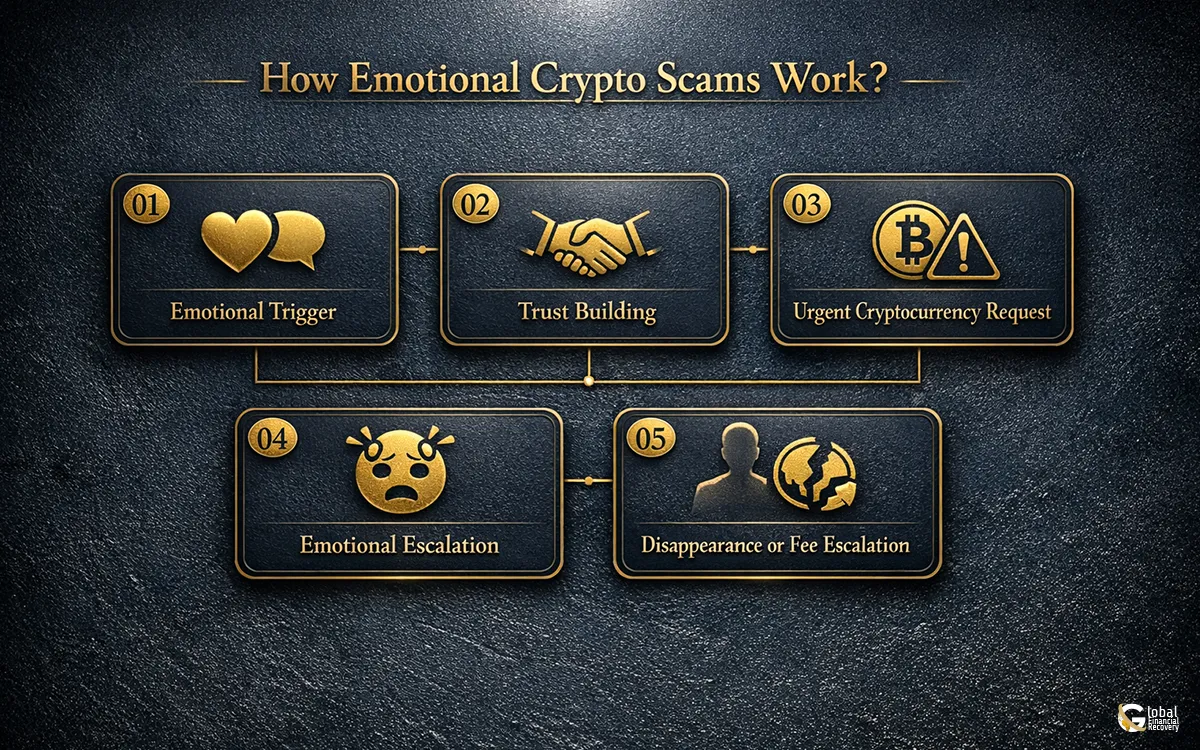
Step 1: Emotional Trigger
The fraud starts with a situation of distress. It may be a health crisis, a love crisis, an emergency donation, or an unexpected financial crisis. This initial step is uncomplicated and provokes empathy and urgency, and then you have no time to verify the facts. When strong emotions are activated first, logical thinking often gets delayed.
Step 2: Trust Building
The scammer then tries to build credibility after the first story. This can be achieved by carrying on the conversation, by providing personal information, by connecting on emotions, or even by sending forged documents and screenshots to make the picture look real.
Over time, the interaction feels real and personal. That familiarity lowers skepticism and makes the request harder to question.
Step 3: Urgent Cryptocurrency Request
Once trust is established, the cryptocurrency request appears. The scammer explains that crypto is the fastest or only solution.
You may hear things like:
- “Bank transfers take too long.”
- “Crypto avoids processing delays.”
- “This must be done immediately.”
The urgency makes the request feel justified, even if it would normally raise concerns.
Step 4: Emotional Escalation
If you hesitate or ask questions, the pressure increases. Guilt, fear, or secrecy may be introduced. The scammer might say, “Please don’t tell anyone,” or suggest that only you can solve the problem.
This escalation is intentional. It’s designed to override doubt and push you toward a quick decision.
Step 5: Disappearance or Fee Escalation
After the cryptocurrency is sent, the emotional intensity often fades. Communication may slow down. New excuses may appear. Additional payments might be requested. In some cases, the scammer disappears entirely.
The emotional story typically ends once the funds are transferred.
Recognizing these steps early can interrupt the scam before irreversible financial loss occurs.
The Psychological Pattern Behind Emotional Crypto Scam
Emotion → Urgency → Crypto Request → Loss
Recognizing this pattern early is your strongest protection.
Common Emotional Tactics Used by Crypto Scammers
The vast majority of emotional crypto scams have the following pattern: instill distress, create urgency, and demand cryptocurrency. Scammers, however, employ various emotional appeals to make the request seem personal and realistic.
The table below outlines the most common compassion- and sympathy-based crypto scam tactics.
|
Scam Type |
How It Works |
What They Say / Do |
|
Fake Medical Emergency Crypto Scam |
A scammer claims a child, spouse, or relative needs urgent surgery or treatment and requests cryptocurrency for hospital bills. |
“My child needs surgery today.” “The hospital only accepts crypto.” “I have no one else to ask.” |
|
Romance-Based Sympathy Crypto Scam |
After building emotional trust through online dating or social media, the scammer introduces a sudden financial emergency. |
“My crypto account is frozen.” “Help me unlock my funds.” “Invest with me so we can build our future.” |
|
Fake Charity or Disaster Relief Crypto Scam |
Fraudsters exploit natural disasters, wars, or crises and ask for crypto donations to a private wallet address. |
“Donate crypto to help earthquake victims.” “Urgent relief fund send USDT now.” |
|
Friend or Family Impersonation Scam |
A hacked or cloned account sends an urgent crypto request claiming financial distress. |
“I’m stranded abroad.” “My bank is blocked send crypto quickly.” |
|
Emotional Investment Loss Scam |
The scammer claims they lost money in crypto trading and need funds to recover losses or unlock profits. |
“I just need a small transfer to release my earnings.” “Help me complete the final payment.” |
|
Urgent Confidential Help Scam |
The scammer pressures the victim to keep the situation secret and send crypto immediately. |
“Don’t tell anyone.” “This must stay between us.” “I’ll repay you tomorrow.” |
If someone pressures you emotionally and insists that cryptocurrency is the only solution, it is likely an emotional crypto scam.
|
Fact: Chainalysis also reports that impersonation scams surged by more than 1,400% in 2025. |
Red Flags of an Emotional Crypto Scam
When a person is emotionally stressed and requests cryptocurrency, take a break. Early detection of the warning signs may save money.
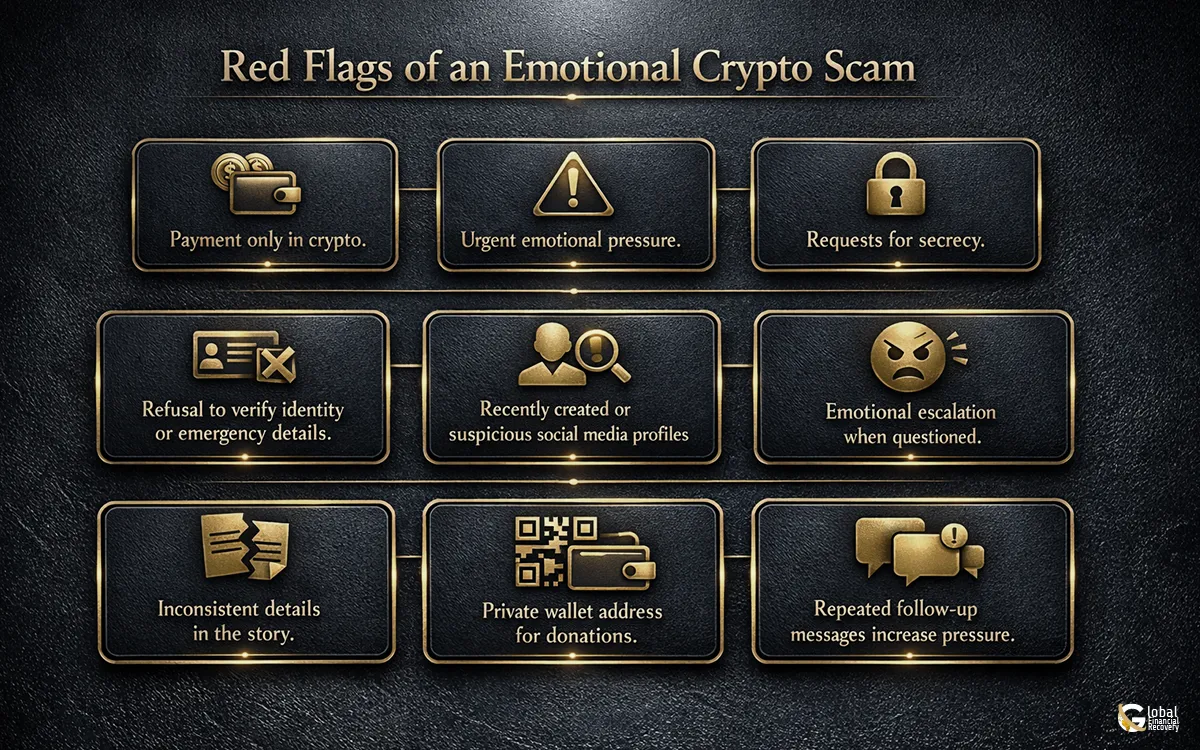
The most typical red flags of an emotional, compassion, or sympathy-based crypto scam, and how knowing each will help you, are shown below.
-
Cryptocurrency is the only accepted payment method
The individual demands Bitcoin, USDT, Ethereum, or any other crypto asset rather than a bank transfer or official charities. If payment can only be made through a private wallet address, recovery becomes extremely difficult. TRM Labs estimates victims sent about $35 billion to crypto fraud schemes in 2025.
-
Urgent emotional pressure
You are told the situation must be resolved immediately, “right now,” “within hours,” or “before it’s too late.” Urgency reduces critical thinking. Slowing down breaks the scammer’s psychological control.
-
Requests for secrecy
The scammer says, “Don’t tell anyone,” or “Keep this between us." Isolation prevents you from getting a second opinion. Scammers know that an outside perspective exposes fraud quickly.
-
Refusal to verify identity or emergency details
They avoid live video calls, official documents, or proof of the emergency. Real emergencies can be verified. Avoiding proof is a major warning sign.
-
Recently created or suspicious social media profiles
The profile may be recently created, have little activity, or have recently changed names. Many scams use fake or hacked accounts.
-
Emotional escalation when questioned
If you hesitate, the tone becomes dramatic, guilt-driven, or accusatory. Emotional escalation is a manipulation tactic designed to override logic.
-
Inconsistent details in the story
Dates, locations, or explanations change when asked simple follow-up questions. Fabricated stories often collapse under basic verification.
-
Private wallet address for donations
You are provided with a random crypto wallet address instead of a tested and approved charity site. Official and transparent payment channels are used by legitimate organizations, not personal transfer of wallet.
-
Repeated follow-up messages increase pressure
Multiple reminders stressing urgency. Pressure is the core mechanism of emotional crypto scams. Persistence signals manipulation.
The Key Protection Principle:
Emotion + Urgency + Crypto Request = High Risk of Fraud
Understanding these red flags helps you interrupt the scam cycle before funds are sent. Once cryptocurrency leaves your wallet, it cannot be reversed like a credit card transaction.
Recognizing manipulation early is your strongest financial defense.
A real U.S. recovery case shows how emotional trust-building in online relationships can lead to devastating crypto losses. See how a victim lost $640,000 in a romance crypto scam case study.
What to Do If You Already Sent Crypto Due to an Emotional Scam?
If you’ve already sent cryptocurrency because of a medical emergency story, romance crisis, or disaster appeal, the most important step is this: Do not send more money.
Emotional crypto scams often escalate. After the first payment, the scammer may claim:
- The transfer was incomplete
- Additional verification is required
- A final processing fee is needed
- The emergency has worsened
This is called fee escalation, and it rarely stops on its own.
TRM analysis shows total illicit crypto activity reached $158 billion in 2025.
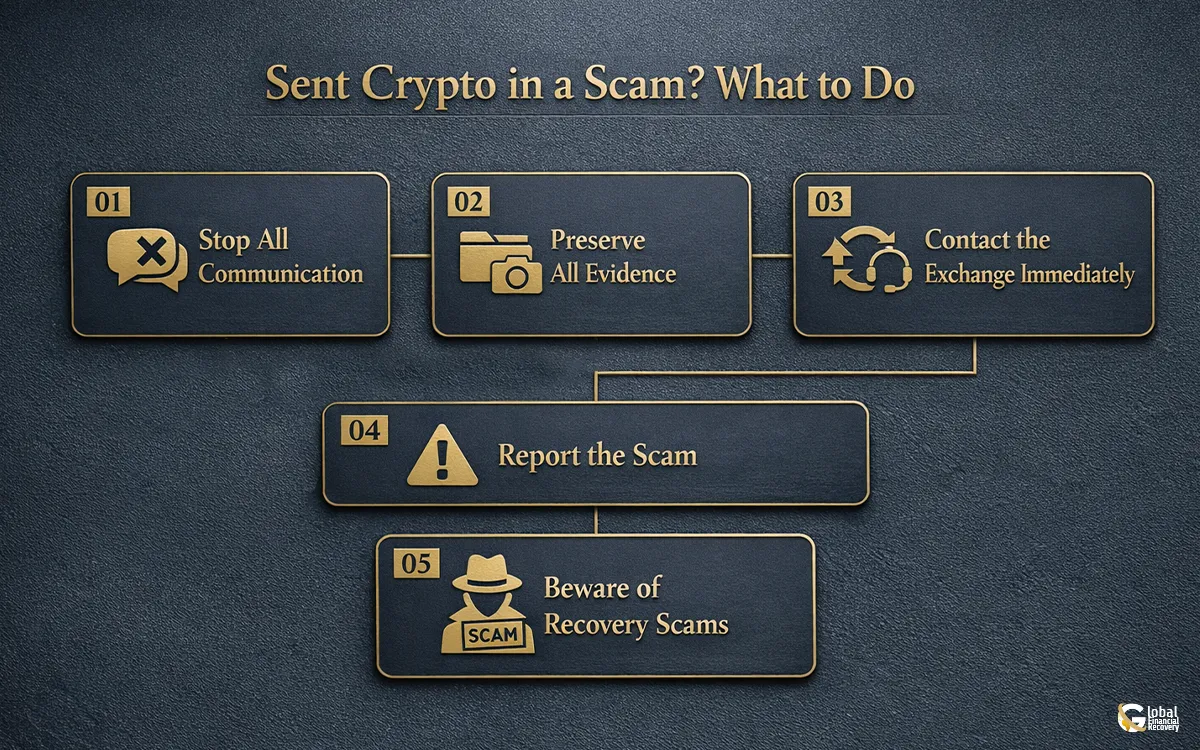
Step 1: Stop All Communication
Do not argue, negotiate, or threaten the scammer. Continued engagement only gives them more opportunities to manipulate you emotionally.
Step 2: Preserve All Evidence
Take screenshots of:
- Wallet addresses
- Transaction IDs (TXIDs)
- Chat conversations
- Social media profiles
- Emails or voice notes
Crypto transactions are irreversible, but they are traceable on the blockchain. Acting quickly improves the possibility of identifying wallet movement patterns.
Step 3: Contact the Exchange Immediately
If you sent crypto from a centralized exchange, report the transaction right away. In some cases, exchanges can flag suspicious wallet activity.
Step 4: Report the Scam
File a report with:
- Your local cybercrime authority
- The crypto exchange used
- Relevant fraud reporting platforms
Reporting helps prevent others from being targeted.
Step 5: Beware of Recovery Scams
Victims of emotional crypto scams are often targeted again by “guaranteed recovery services” demanding upfront fees. Legitimate cryptocurrency recovery professionals do not guarantee results or demand large payments before analysis.
They seem just like real ones, but in the end, they don't recover your money and also ask for fees, which is then known as a recovery scam.
Important: The displayed “balance” shown by a scammer may never have been real. Many emotional scams use simulated dashboards or fake screenshots. Taking fast, calm action is critical.
Staying Safe from Emotional Crypto Scams
Emotional crypto scams succeed because they feel real. The process of execution begins with a narrative that triggers compassionate feelings while creating urgent situations, which establish trust between people. The emotional appeal stops working when people send their cryptocurrency because they lose all their money.
People should treat situations that involve strong emotions and urgent time limits and crypto-based requests as major danger signals. The process of independent verification through delayed investigation helps to protect against permanent, destructive effects.
If you suspect you fell victim to an emotional or sympathy-based crypto scam, you should contact Global Financial Recovery for recovery assistance. Your ability to feel empathy stands as your greatest strength, yet you must exercise caution during your crypto transactions.
FAQs (Frequently Asked Questions)
Yes. Fake medical records, edited screenshots, and copied charity materials are commonly used in emotional crypto scams. Digital documents are easy to manipulate, so always verify through official channels.
Scammers prefer cryptocurrency because it moves quickly and can’t be easily recovered. Once you send crypto to a private wallet address, no bank can reverse the transaction. That’s why fake medical emergencies, disaster appeals, or romantic crises are often used to request crypto.
Cryptocurrency donations might be valid, however, when the organization is verified separately. In times of disaster, fraudsters may come up with bogus charities and request their contributions to their individual wallet accounts rather than the authorities. Always ensure that the source is authentic before remittance of funds.
No. Legitimate organizations use transparent, official payment systems. If someone asks you to send cryptocurrency directly to a personal wallet — especially under pressure — that’s a serious red flag.
Yes. Many emotional or sympathy-based crypto scams begin on Instagram, Facebook, WhatsApp, Telegram, and dating apps. Scammers often use fake or hacked accounts to build trust before asking for cryptocurrency.
Recover Your Scammed Money Now
Recent Posts


Empowering you to reclaim what's rightfully yours. Together, we stand strong against financial fraud.