
I Paid the “Tax” to Withdraw My Crypto: That’s When Everything Fell Apart
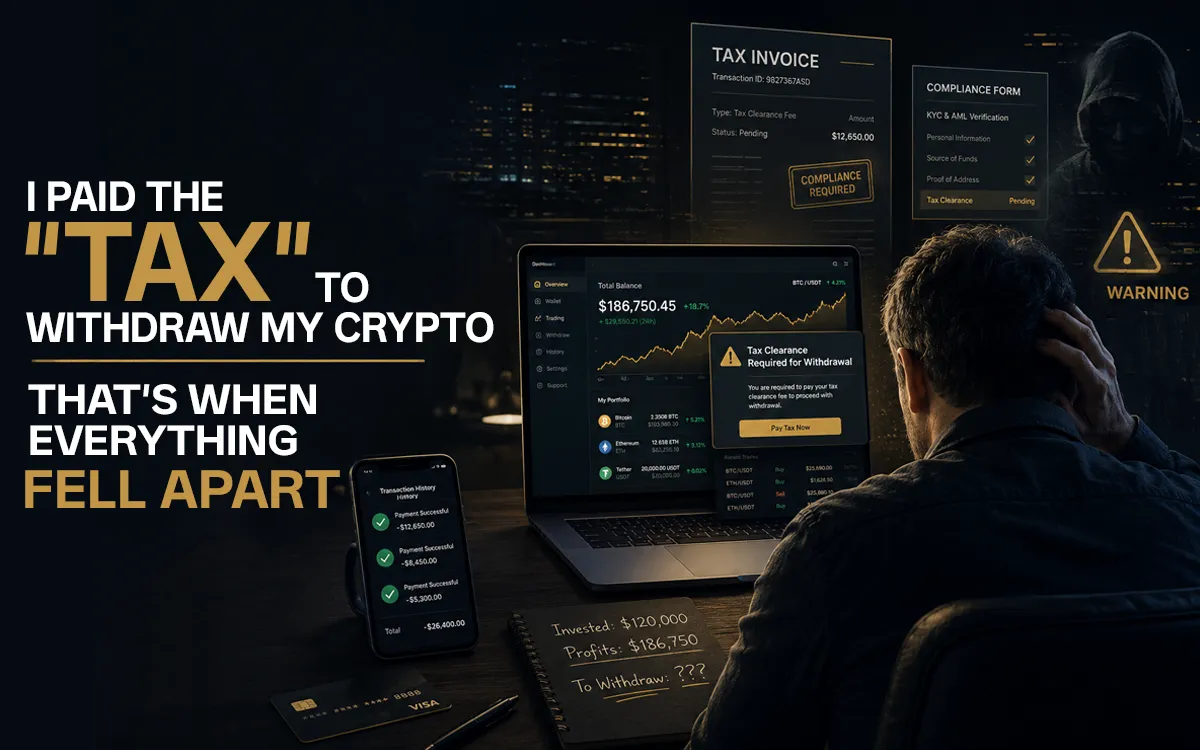
When they told me I had to pay taxes before withdrawing my crypto, I didn’t immediately think “scam.”
I thought it was just part of the process; after all, paying taxes meant the profits were real… right? Or so I thought.
My name is Mark, I’m 47, and I’m based in Texas. I got into crypto trading after seeing a few success stories online. That’s how I found the platform; everything about it looked legitimate: professional design, responsive support, and a dashboard that showed my investments steadily growing.
I started small. A few thousand dollars just to test things out. The trades seemed to work, and I saw consistent returns. Over time, I added more funds, feeling more confident with each step.
Before I knew it, I had invested around $120,000, and I was seeing what looked like a significant profit on that investment.
It felt real. It looked real. And that’s what made everything that came next so convincing.
When I decided to withdraw some of my funds, I was told I needed to pay a tax clearance fee first. They explained it as a compliance requirement tied to the profits I had made. They even provided documents, which looked like official forms and transaction summaries.
At the time, it didn’t raise alarms.
If anything, it reassured me.
So I paid.
Then came another request, this time for an additional “tax adjustment.” That’s when I paused.
Something didn’t feel right anymore.
I started searching for things like"Do you pay crypto taxes before withdrawal?" "Is crypto tax upfront payment a scam?"and "Why is a trading platform asking for tax fees before releasing funds?”
That’s when it hit me.
The profits weren’t real.
And the “tax” was never a requirement.
It was a scam.
I had already sent a large amount, and I didn’t know if anything could be done. I felt stuck in a crypto tax scam.
While trying to understand what had happened, I came across Global Financial Recovery. What helped most in the beginning was how clearly they explained the structure of crypto tax scams, how fake profits are used to justify upfront tax payments, and why these platforms delay withdrawals in the first place.
They also pointed me toward resources and guides on similar crypto tax scams, which honestly helped me connect a lot of the dots I had missed while it was happening.
They offered a free case evaluation, had no upfront fees, and were realistic about the situation from the start. No guarantees, just a clear explanation of what could still be possible. The process took time, but in the end, I was able to recover a meaningful portion of what I had lost. Not everything, but far more than I expected at that stage.
What stayed with me most was realizing how normal the tax payment had sounded while it was happening. That was the part I never stopped to question until much later.
And once I finally understood what was actually happening, getting the right guidance made it easier to figure out what to do next instead of trying to make sense of it alone.
Many scam victims hesitate to talk about what happened or worry they will be judged, rushed, or pressured. At Global Financial Recovery, the goal is to understand your situation first. Just explain how things started. You can speak openly at your own pace through a free and confidential case evaluation.
Book A Free Consultation

From case evaluation to financial investigation, Global Financial Recovery provides transparent guidance to help you understand your case and explore your options.