
NFT Tax Scams Explained: Real Taxes vs Fake Tax Demands

- Investments
- Updated On: February 26, 2026
Table of Contents
If an NFT platform, marketplace, or individual tells you that you must pay taxes before you can access or withdraw your funds, this is a major warning sign of an NFT tax scam. These schemes exploit confusion around NFT taxation by inventing withdrawal taxes, compliance fees, gas charges, or “clearance” payments that have no legal basis. Instead of real tax obligations, victims are presented with fabricated demands designed to block withdrawals and pressure them into sending cryptocurrency to scam-controlled wallets.
As NFT investing and trading have grown, NFT withdrawal tax scams and fake crypto tax requests have become increasingly common, especially when investors attempt to cash out profits. Scammers often use professional-looking dashboards, fake transaction histories, and official-sounding messages to make these tax claims appear legitimate. In reality, legitimate NFT taxes are handled through proper tax reporting after profits are realized, not through upfront payments to platforms or private wallets.
In this guide, we explain how NFT tax scams actually operate, how to distinguish real NFT taxes from fake tax demands, the most common red flags, and what steps to take if you’ve already sent money or had your withdrawal blocked.
What Are NFT Tax Scams?
NFT tax scams are a form of crypto fraud where scammers falsely tell investors they must pay a tax or fee before they can withdraw, sell, or access their NFT funds. These “taxes” are completely made up. The goal is to pressure victims into sending cryptocurrency directly to a scam-controlled wallet under the excuse of tax compliance.
In many cases, the scammer pretends to represent an NFT marketplace, a trading platform, or a tax or compliance department. Victims are told they must clear an NFT tax, capital gains charge, or withdrawal fee before their profits can be released. This tactic is widely used in NFT crypto tax fraud and other fake NFT tax payment scams.
In order to trick people more easily, scammers tend to generate entire dashboards that appear to be very professional, create fake transaction histories, and even simulate customer support conversations.
The same method of refusing withdrawals has been used in various other types of investment scams as well, for instance, in fraudulent trading platforms where the users are cornered through the demand of made-up fees before the release of their withdrawals, a scheme we have recorded through real-life situations on our website.
Most importantly, legitimate NFT taxes are never collected upfront by platforms or private individuals, and no genuine service will ask you to pay taxes directly in cryptocurrency.
How NFT Tax Scams Work?
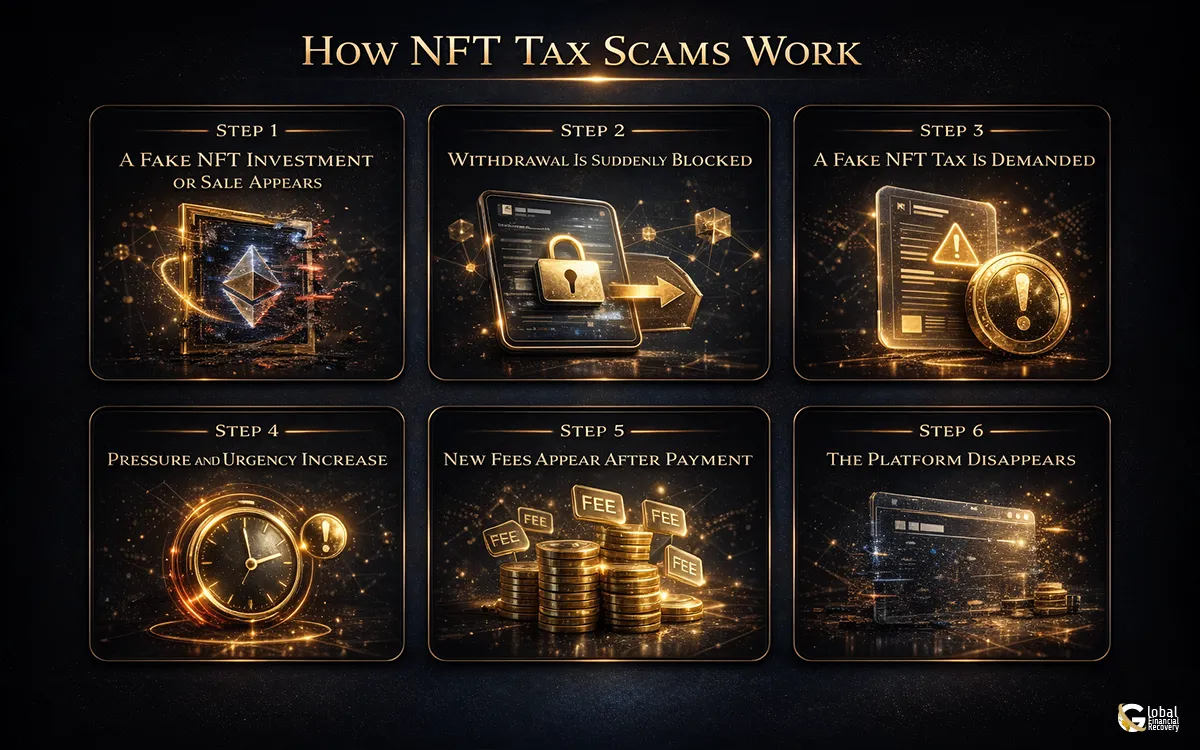
Most NFT tax scams follow a predictable pattern. They are carefully designed to look legitimate while slowly pushing victims toward fake tax payments. Understanding each step makes it much easier to spot the scam early.
Step 1: A Fake NFT Investment or Sale Appears
The scam often begins when an investor is shown what looks like a successful NFT trade or sale. This may happen on a fake NFT marketplace or a cloned trading platform. The dashboard shows profits, balances, or pending withdrawals that appear real but are entirely fabricated.
This is the same setup used in many fake trading platforms, where numbers are manipulated to create false confidence, something we’ve seen repeatedly in real scam cases.
Step 2: Withdrawal Is Suddenly Blocked
When the victim tries to withdraw their NFT profits, the platform blocks the request. A message appears claiming the account is restricted due to “tax requirements,” “capital gains rules,” or “regulatory checks.” This is where NFT crypto tax fraud begins to surface.
At this stage, scammers rely on confusion around NFT taxes to make the restriction feel normal.
Step 3: A Fake NFT Tax Is Demanded
The victim is told they must pay an NFT tax, withdrawal tax, or clearance fee before funds can be released. This demand is usually framed as mandatory and time-sensitive. In most fake NFT tax payment scams, the tax must be paid in cryptocurrency, not through any official tax authority.
Legitimate NFT taxes are never collected this way.
Step 4: Pressure and Urgency Increase
Scammers escalate the pressure by adding deadlines, warnings, or threats of account suspension. Victims may be told the funds will be frozen permanently if the tax is not paid quickly.
Step 5: New Fees Appear After Payment
If the victim pays the fake NFT tax, the scam does not end. Instead, new fees appearsuch as “release charges,” “liquidity fees,” or “verification costs.” This looping demand for payments is a hallmark of NFT tax scams and fake trading platforms.
Step 6: The Platform Disappears
Eventually, communication stops. The website goes offline, support chats vanish, or the victim is blocked entirely. By this point, the cryptocurrency sent as “tax” has already been moved through multiple wallets to make tracing more difficult.
7 Common Types of NFT Tax Scams
NFT tax scams don’t all look the same. Fraudsters use different tactics depending on how far along a victim is in the process, whether it’s a first-time NFT sale or an attempted withdrawal.
The table below breaks down the most common NFT tax scams so you can quickly recognize how each one works and what warning signs to watch for.
|
Type of NFT Tax Scam |
How the Scam Works |
What Scammers Say |
|
Fake NFT Capital Gains Tax Scam |
Scammers claim you earned NFT profits and must pay capital gains tax before withdrawals are allowed. The profits shown are fake. |
“You must pay capital gains tax before your profits can be released.” |
|
NFT Withdrawal Tax Scam |
Withdrawals are blocked until a fake tax or clearance fee is paid. This is one of the most common NFT tax scams. |
“Your withdrawal is pending tax clearance.” |
|
NFT Tax Refund Scam |
Victims are told they overpaid NFT taxes and must pay a small fee to receive a refund. |
“You qualify for an NFT tax refund, but processing requires a small fee.” |
|
NFT Marketplace Impersonation Scam |
Fraudsters impersonate real NFT marketplaces and demand taxes through fake emails or support chats. |
“Your NFT account requires tax verification to remain active.” |
|
Compliance or Verification Tax Scam |
Scammers claim NFT funds are under review and require tax payment to verify ownership. |
“Your funds are under compliance review. Tax verification is required.” |
|
Fake Government NFT Tax Notice |
Victims receive emails or messages pretending to be from a tax authority demanding immediate NFT tax payment. |
“Failure to pay NFT tax immediately may result in penalties or legal action.” |
|
NFT Penalty or Late Tax Scam |
After an initial payment, scammers claim penalties or late fees are owed to fully release funds. |
“A late tax penalty must be paid before funds can be unlocked.” |
While the names and explanations may vary, every NFT crypto tax fraud follows the same goal: to pressure victims into paying fake taxes or penalties that do not legally exist.
Recognizing these scam types early can help you avoid losses and stop scammers before they demand additional fees.
Now that you know the most common NFT tax scam variations, the next step is learning how to identify the red flags that clearly signal a fake tax demand.
8 Red Flags of NFT Tax Scams
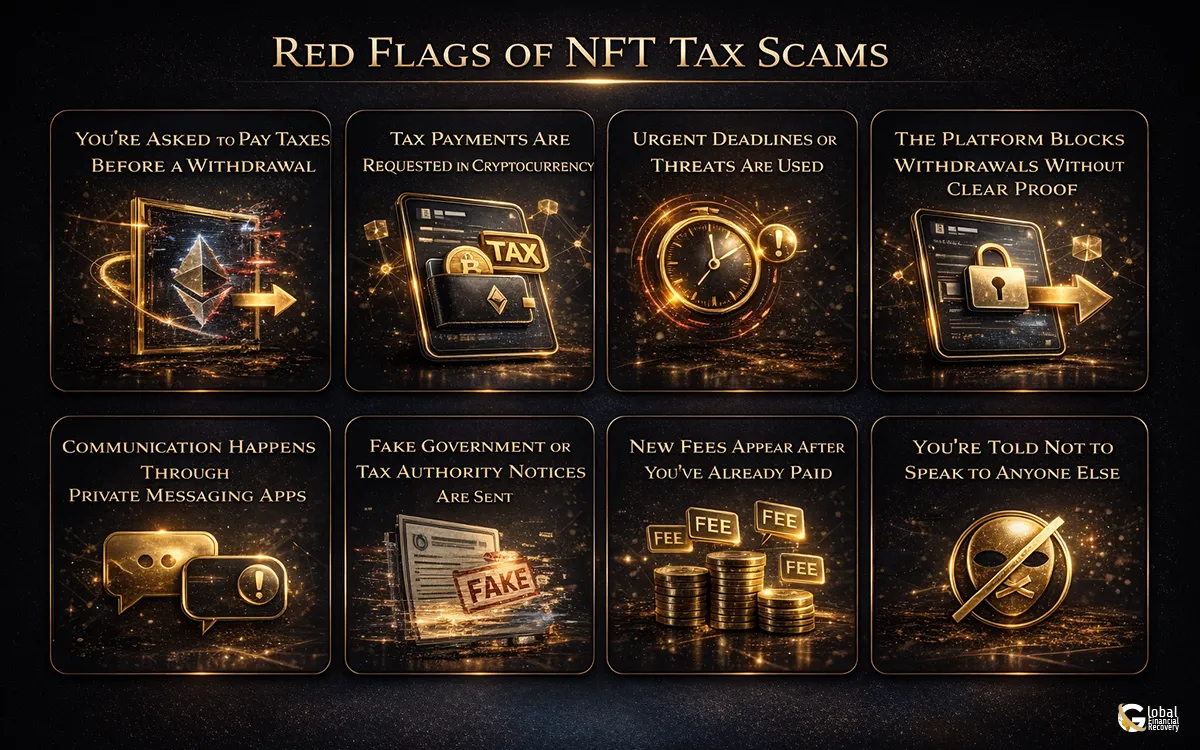
Knowing the warning signs of NFT tax scams can stop losses before they happen. Scammers rely on confusion, urgency, and fear. When you understand these red flags, you regain control and can pause before making costly decisions.
1. You’re Asked to Pay Taxes Before a Withdrawal
In legitimate systems, taxes are reported separately through official tax filings, not paid upfront to unlock funds. Any request to pay an NFT tax before withdrawal is a key sign of NFT crypto tax fraud. It allows you to stop immediately and avoid sending crypto to a scam wallet before funds are lost.
2. Tax Payments Are Requested in Cryptocurrency
Real tax authorities do not collect taxes through private crypto wallets. Requests to pay NFT taxes in Bitcoin, USDT, or Ethereum are common in fake NFT tax payment scams. You can instantly identify the request as illegitimate and avoid irreversible crypto transfers.
3. Urgent Deadlines or Threats Are Used
Scammers create panic by threatening frozen accounts, penalties, or legal action. These urgency tactics are designed to stop you from verifying the claim. Recognizing pressure tactics gives you the confidence to slow down, verify facts, and avoid emotional decisions.
4. The Platform Blocks Withdrawals Without Clear Proof
Fake NFT platforms often freeze withdrawals and provide vague explanations involving taxes or compliance. This is a common tactic in NFT withdrawal tax scams. It helps you identify platform manipulation early and prevents you from paying fake fees to regain access.
5. Communication Happens Through Private Messaging Apps
Legitimate platforms and tax authorities do not handle tax matters through WhatsApp, Telegram, or private chats. Scammers prefer these channels because they are harder to trace. It alerts you that the interaction lacks accountability and should not be trusted.
6. Fake Government or Tax Authority Notices Are Sent
Some scammers impersonate government agencies to demand NFT tax payments, penalties, or late fees. These messages often look official but contain false claims. It prevents fear-based payments and reminds you that real authorities never demand crypto payments.
7. New Fees Appear After You’ve Already Paid
Once a victim pays, scammers often invent additional penalties or verification fees. This is known as fee-stacking and is common in NFT penalty or late tax scams. It helps you recognize that the scam will not end with one payment and stops further losses.
8. You’re Told Not to Speak to Anyone Else
Scammers isolate victims to prevent outside advice. They may warn against contacting banks, tax professionals, or recovery experts. It encourages you to seek verification and support before making irreversible decisions.
If any NFT platform or individual asks you to pay taxes, penalties, or clearance fees before releasing funds, it is almost certainly an NFT tax scam.
What to Do If You've Been Scammed by an NFT Tax Scam?
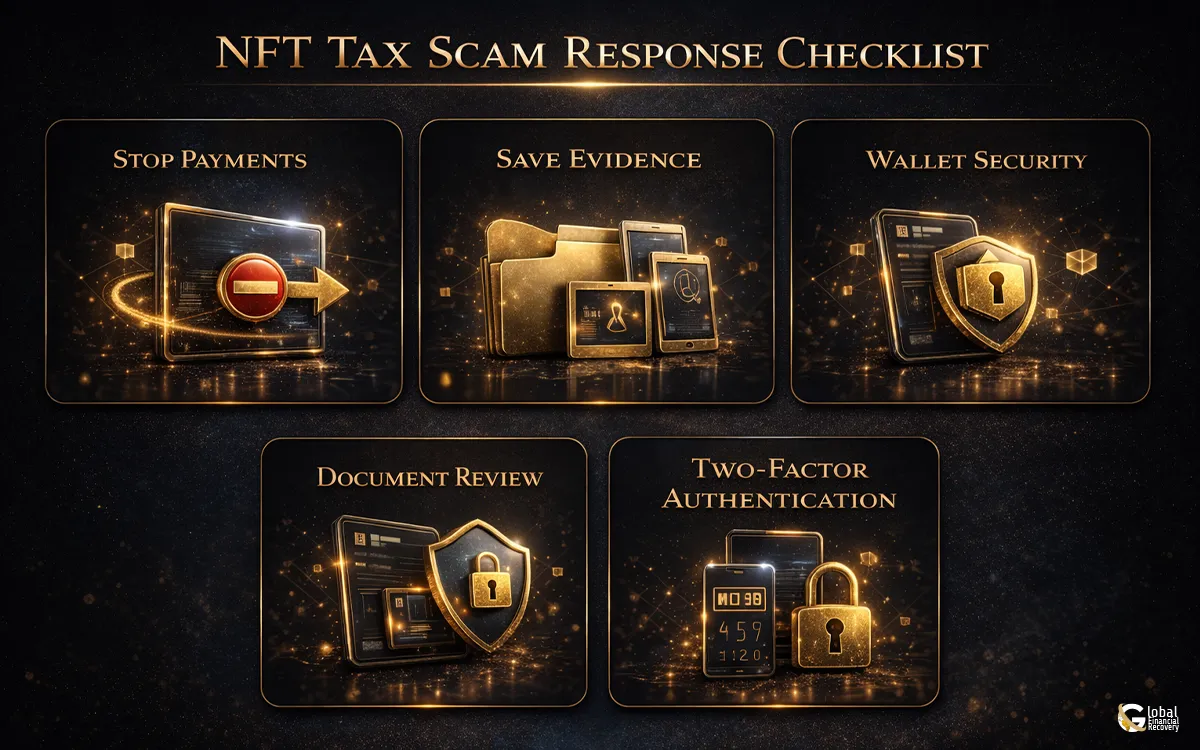
If you’ve already sent money because of an NFT tax scam, the most important step is to stop all payments immediately. Scammers often claim that one final tax, penalty, or clearance fee will unlock your NFT funds, but this is never true.
Fake NFT tax payment scams are built to keep extracting money for as long as the victim continues paying. Cutting off payments early helps limit further losses and prevent the scam from turning into repeated NFT penalties or late tax scams.
Once payment has been made, it is equally important that communication with the scammer be terminated altogether. Further response only serves to give them more opportunities to exert pressure, cause confusion, or come up with new fees.
Rather, protect yourself by collecting and storing all evidence relating to the NFT crypto tax fraud. This should include wallet addresses, transaction IDs, payment confirmations, conversation screenshots, platform dashboards, emails, and any fake NFT tax notices you might have received. Keeping such information well-arranged could be of great help to you in case you decide to seek support from scam investigation or recovery services in the future.
Be wary of anyone who approaches you with promises of instant or guaranteed recovery. A large number of NFT tax scam victims fall prey to recovery fraud again, where fraudsters ask for upfront fees while giving unrealistic assurances. Genuine tax scam recovery does not use pressure, urgency, or guarantees as its tools.
If you have given wallet access to someone, linked your wallet to unfamiliar platforms, or clicked on suspicious links, you should immediately take steps to protect your assets. These include transferring your remaining funds to a new wallet, changing passwords, enabling two-factor authentication, and checking wallet permissions.
Most importantly, give yourself time and avoid panic-driven decisions. Paying a fake NFT tax does not mean you broke the law or did something wrong. These scams exist because NFT taxation can be confusing even for experienced crypto investors.
NFT tax fraud succeeds by exploiting fear, urgency, and uncertainty. Staying calm and informed now puts you in a much stronger position to understand your options and protect yourself going forward.
Real NFT Taxes vs Fake NFT Tax Scams
|
Aspect |
Real NFT Taxes |
Fake NFT Tax Scams |
|
Who collects the tax |
Government tax authorities through official tax filing |
Scammers posing as platforms, support agents, or “tax teams.” |
|
When taxes are paid |
After profits are realized, during tax reporting |
Before withdrawal, it often occurs suddenly and without warning |
|
How payment is made |
Through official tax payment methods |
Direct crypto transfers to private wallets |
|
Purpose of the payment |
To report and settle taxable gains |
To block withdrawals and extract more money |
|
Documentation provided |
Formal tax records and filings |
Fake notices, screenshots, or no documentation |
|
Effect on withdrawals |
Withdrawals are not blocked by tax payments |
Funds remain locked even after payment |
|
Refund promises |
Taxes are not refundable |
Scammers promise refunds to pressure payment |
|
Fee changes |
Tax amounts are calculated and fixed |
Fees change repeatedly with new excuses |
|
Communication style |
Formal, verifiable, and non-urgent |
Urgent, threatening, and time-pressured |
|
Connection to other scams |
None |
Often linked to fake trading platforms and NFT investment scams |
Staying Safe From NFT Tax Scams
NFT tax scams succeed because they take advantage of uncertainty around crypto rules and strike at the moment investors attempt to withdraw funds. It’s important to remember that legitimate NFT platforms do not require upfront taxes, gas fees, or compliance payments to release your money. Any demand like this is a clear warning sign of an NFT tax scam.
If you’ve already been affected or suspect you’re dealing with NFT crypto tax fraud, you don’t have to handle it alone. Global Financial Recovery helps victims understand what happened, document the scam properly, and explore realistic recovery options. Reaching out early can help protect your next steps and reduce the risk of further losses.
FAQs (Frequently Asked Questions)
No. A legitimate NFT platform does not block withdrawals to collect taxes. While platforms may pause withdrawals for security checks, taxes are handled separately through official tax reporting. If a platform demands tax payment before releasing your funds, it’s a strong sign of an NFT tax scam.
Crypto payments are harder to reverse and easier to move across multiple wallets. Scammers rely on this to disappear quickly after receiving funds. Real tax authorities do not collect taxes through private crypto wallet transfers.
Yes. This is a common tactic in NFT penalty and late tax scams. Once scammers know a victim is willing to pay, they often invent new charges to extract more money. Legitimate tax systems do not work this way.
No. Ignoring a fake NFT tax demand will not cause legal problems. These notices are fabricated and often impersonate authorities. Real tax agencies communicate through official channels and never demand urgent crypto payments.
Pause and verify. Check the sender’s email domain, avoid clicking links, and never act under pressure. If the message asks for immediate payment, uses threats, or requests crypto transfers, it is almost certainly a scam. When in doubt, seek professional guidance before taking action.
Book A Free Consultation
Recent Posts

Empowering you to reclaim what's rightfully yours. Together, we stand strong against financial fraud.