
How Global Financial Recovery Handles Your Personal and Financial Information
- Miscellaneous
- Updated On: October 1, 2026
Table of Contents
After losing money to a scam, sharing more personal and financial information can feel uncomfortable. If you are considering fund recovery services or professional help, you may need to provide transaction records, payment details, screenshots, messages, wallet addresses, or information about the platform involved.
It is reasonable to ask how that information will be handled.
At Global Financial Recovery, crypto scam recovery investigations start with case reviews, and financial investigations depend on the information available about the loss. The information you provide helps the team understand what happened, review the available evidence, and determine what further investigation may be appropriate.
We explain in our Privacy Policy how personal information may be collected, used, and disclosed. Our Terms and Conditions also explain that information may be shared with trusted partners, financial institutions, or relevant authorities when necessary to provide and support our recovery service.
Why Privacy Matters During a Financial Investigation
Financial scam cases can involve sensitive information.
A review may include:
- Bank or payment records
- Cryptocurrency transaction records
- Wallet addresses and transaction IDs
- Emails and messages
- Screenshots of conversations or account activity
- Details about a trading or investment platform
- Information about payments made to scammers
- Other records that may help explain what happened
This information can help investigators understand how the scam happened and how money moved.
Global Financial Recovery focuses on reviewing available evidence, analyzing financial activity, tracing relevant transactions, and assessing possible recovery options. The information provided by a client can therefore be an important part of the investigation.
What Information May Be Collected?
The information needed depends on the circumstances of each case. For a cryptocurrency scam investigation, crypto scam recovery services may review wallet addresses, transaction hashes, exchange records, screenshots, and communications with the person or platform involved. This information can help investigators understand the movement of funds and assess possible crypto asset recovery options.
A trading or investment scam may also involve account records, payment receipts, emails, website details, and information about withdrawal requests.
Thus, you do not need to have every possible document before asking for a case evaluation. Start with the information you have. It can help establish what happened and what further evidence may be useful.
How Is Your Information Used During a Case Review?
Information provided during a case review may be used to understand the circumstances of the financial loss and support the investigation.
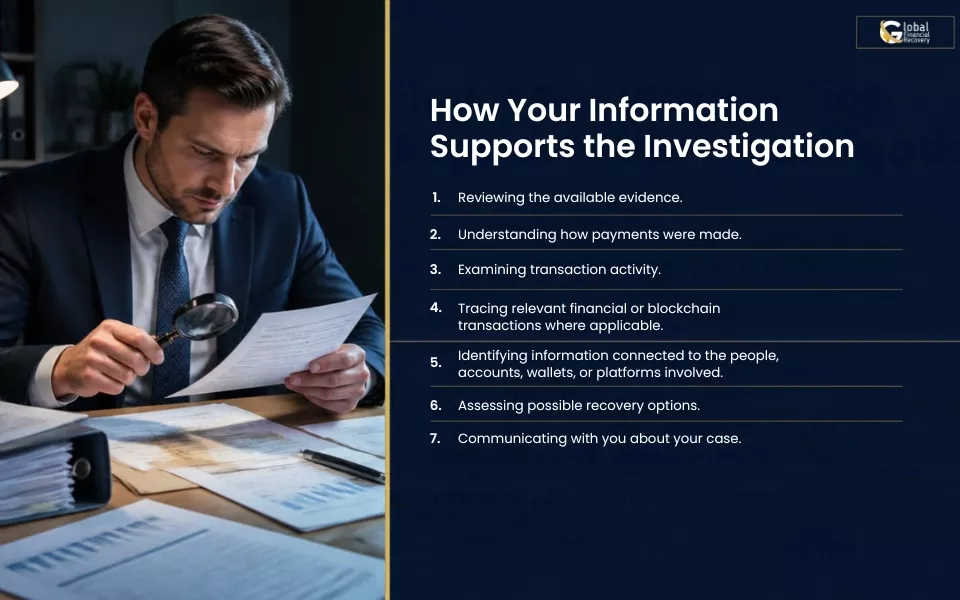
Depending on the case, this may include:
- Reviewing the available evidence
- Understanding how payments were made
- Examining transaction activity
- Tracing relevant financial or blockchain transactions where applicable
- Identifying information connected to the people, accounts, wallets, or platforms involved
- Assessing possible recovery options
- Communicating with you about your case
The information you provide can help build a clearer picture of what happened, how the funds were sent, and what we can establish from the available records. The goal is to use information that is relevant to understanding the case rather than collecting information that has no connection to the investigation.
These activities are part of the broader case review and investigation process at Global Financial Recovery. To learn more about how a case moves from the initial review through evidence analysis, financial investigation, transaction tracing, and recovery assessment, see how global financial recovery works.
The current Terms and Conditions also explain that information may be collected and shared when needed to assist with a case.
How Global Financial Recovery Handles Your Case Information
When you share information after a financial scam, it is natural to want to know what happens to it. Some cases may involve sensitive financial records, transaction details, wallet addresses, screenshots, messages, and other information that helps explain the loss.
Global Financial Recovery uses relevant case information to review the circumstances of a financial loss and support its investigation. Depending on the case, some information may also need to be shared or disclosed for specific purposes. The table below explains who may receive information, when it may be disclosed, and how it may be used during an investigation.
|
What you may want to know |
How Global Financial Recovery handles it |
|
Who may receive your information? |
Information provided during a case may need to be shared with trusted partners, financial institutions, or relevant authorities when this is necessary to support case-related work. For example, financial records may be relevant when reviewing a transaction with a financial institution, while certain case information may need to be provided to an appropriate authority. Any sharing is considered within the purposes described in the Privacy Policy and Terms and Conditions. |
|
When can information be disclosed? |
There may be situations where personal information needs to be disclosed for legal or other legitimate reasons. This can include responding to legal requests, court orders, or other legal processes, as well as protecting legal rights or meeting other obligations. This means confidentiality should not be understood as a promise that information will never be disclosed under any circumstances. The Privacy Policy explains these situations in more detail. |
|
How is your information used during an investigation? |
Information is used to help understand the circumstances of a financial loss and review the evidence available. Depending on the case, this may include examining payment records, reviewing communications and platform information, analyzing financial activity, or tracing cryptocurrency transactions and wallet activity where applicable. The purpose is to establish what happened and assess whether there may be reasonable recovery options based on the available evidence. |
|
Why is this information needed? |
Financial investigations often depend on records that show how money was sent and where it may have moved. Transaction IDs, wallet addresses, payment records, screenshots, messages, and platform details can help connect different parts of a case. The information requested should relate to understanding the loss, reviewing the financial activity, or supporting the investigation. |
|
Does sharing information mean it will always remain completely private? |
No company can promise absolute privacy or security in every situation. Global Financial Recovery's Privacy Policy explains that reasonable measures are used to protect personal information, while also recognizing that electronic storage and transmission cannot be guaranteed to be completely secure. Information may also need to be disclosed in circumstances explained in the Privacy Policy and Terms and Conditions. |
What Confidentiality Does and Does Not Mean
It is important to have realistic expectations about online privacy.
Global Financial Recovery's Privacy Policy states that reasonable measures are used to protect personal information, but no method of transmitting or storing information electronically can be guaranteed to be completely secure.
In simple terms, confidentiality means that information is handled according to the company's privacy practices and used for legitimate purposes connected to the service.
It does not mean that:
- Information can never be shared
- Information can never be disclosed for legal reasons
- Electronic systems are completely risk-free
- A company can guarantee absolute security
Being clear about these limits is important when dealing with sensitive financial information.
How You Can Protect Your Information
You also have a role in protecting your information during and after a scam.
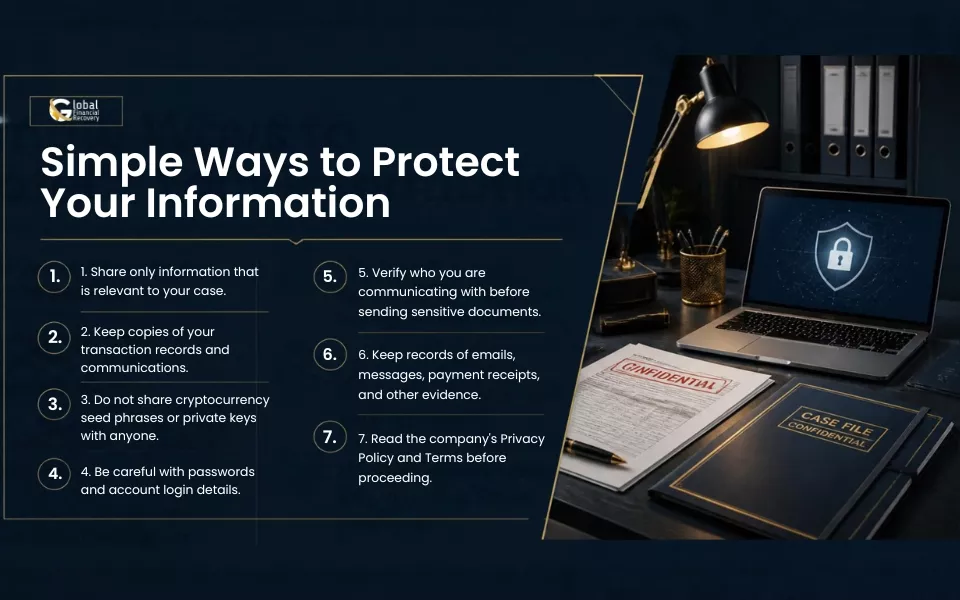
A few simple steps can help:
- Share only information that is relevant to your case.
- Keep copies of your transaction records and communications.
- Do not share cryptocurrency seed phrases or private keys with anyone.
- Be careful with passwords and account login details.
- Verify who you are communicating with before sending sensitive documents.
- Keep records of emails, messages, payment receipts, and other evidence.
- Read the company's Privacy Policy and Terms before proceeding.
Most importantly, never give someone your private key or seed phrase as part of a recovery process. Those details can provide direct access to a cryptocurrency wallet.
Read the Privacy Policy Before Sharing Sensitive Information
Before providing personal or financial information to any recovery company, take time to understand its privacy practices.
The Global Financial Recovery Privacy Policy explains how personal information may be collected, used, protected, and disclosed. The Terms and Conditions also explain how information may be used when assisting with a case.
Reading these documents can help you understand what to expect before moving forward.
If you have questions about how your information may be handled, you can also contact Global Financial Recovery directly.
Clear Information Matters After a Scam
Losing money to a scam can leave you with many questions. Privacy should not be another source of uncertainty.
A financial investigation may require sensitive records because those records can help establish what happened and where money moved. At the same time, you should understand why information is being requested, how it may be used, and when it may need to be shared.
Global Financial Recovery's approach is centred on reviewing available evidence, investigating financial activity, and explaining findings based on the information available. Recovery is not guaranteed, and each case depends on its own evidence and circumstances.
Understanding the privacy practices before sharing information can help you make a more informed decision about seeking professional assistance. A free case evaluation provides an opportunity to discuss your situation, review the information available, and understand what may be relevant to a financial investigation.
FAQs (Frequently Asked Questions)
Start with information that helps explain the scam and how your money moved. This may include transaction records, payment receipts, wallet addresses, transaction IDs, emails, messages, screenshots, platform details, and communications with the person or company involved. You do not need to have every record before requesting an initial case evaluation.
Information may be shared when it is necessary to assist with a case. The Terms and Conditions state that this may include sharing information with trusted partners, financial institutions, and relevant authorities. The exact circumstances depend on the case and are also addressed in the company's Privacy Policy.
No company can guarantee absolute security for information stored or transmitted electronically. Global Financial Recovery's Privacy Policy explains that reasonable measures are used to protect personal information while also recognizing that no electronic system can be completely secure.
Yes. The Privacy Policy explains how personal information may be collected, used, and disclosed. If you have questions about information connected to your case, you can contact Global Financial Recovery for clarification.
No. A private key or seed phrase can provide access to a cryptocurrency wallet and should not be shared as part of a normal case review. Transaction IDs, wallet addresses, screenshots, and other records can provide useful information without giving another person control of your wallet.
Book A Free Consultation
Recent Posts


From case evaluation to financial investigation, Global Financial Recovery provides transparent guidance to help you understand your case and explore your options.