
Nigerian National Convicted in $7.5M U.S. Charity Cyber Fraud

MARYLAND, USA — December 2025
A U.S. federal court has convicted a 32-year-old Nigerian national for carrying out a cyber fraud scheme that siphoned more than $7.5 million from two charitable organizations, according to the U.S. Department of Justice.
Olusegun Adejorin, who was the defendant, was convicted on the basis of a six-day jury trial in the federal court in Maryland. According to prosecutors, he was found guilty of various crimes, which included wire fraud, aggravated identity theft, and accessing a secured computer without authorization. The charges were pressed, and Adejorin was extradited to the United States, where he was to stand trial.
The federal authorities reported that the fraud occurred between June and August of 2020 and involved one Maryland-based charity and another based in New York. Investigators determined that Adejorin illegally accessed employee email accounts and posed as staff members involved in financial operations, a tactic often used in email phishing scams.
In a statement, the Justice Department said a federal jury convicted Adejorin of using stolen identities and compromised systems to obtain sensitive information and manipulate internal communications related to large financial transactions.
According to prosecutors, Adejorin registered spoofed email domain names that closely resembled the charities’ legitimate addresses. Using those fake domains, he sent withdrawal requests while also accessing internal email accounts to falsely confirm the transactions, making them appear legitimate.
The scheme ultimately led to more than $7.5 million being transferred into bank accounts that had no connection to either charity, the DOJ said.
The investigation of the money trail of the fraud was conducted by U.S. Attorney Kelly O. Hayes, together with Jimmy Paul, the Special Agent in Charge of the Baltimore Field Office of the FBI, who praised the investigators. Assistant U.S. Attorneys Joshua Rosenthal and Darren S. Gardner were the prosecutors in the case.
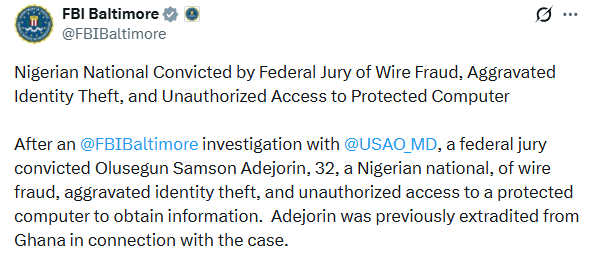 “Source: FBI”
Adejorin now has to spend much time in jail. It was indicated that federal prosecutors can sentence him to up to 20 years of prison on each of the five counts of wire fraud, up to five years of unauthorized access to a protected computer, and a two-year sentence of aggravated identity theft, which must not be served concurrently.
He is to be sentenced on April 10, 2026, before U.S. District Judge Theodore D. Chuang. According to the Justice Department, federal sentences are often lower than the statutory maximum because judges refer to sentencing guidelines and other legal provisions.
Authorities verified that the case is under Operation Take Back America, which is a nationwide DOJ program that is designed to combat organized crime, cyber fraud, and financial abuse of U.S. institutions.
Book A Free Consultation
Recent News
Empowering you to reclaim what's rightfully yours. Together, we stand strong against financial fraud.