
Crypto Withdrawal Fee Scams: How They Work and How to Avoid Them
- Cryptocurrency
- Updated On: July 22, 2026
Table of Contents
One of the most frustrating situations for cryptocurrency investors is discovering that they cannot withdraw their money. After weeks or even months of watching their account balance grow, they submit a withdrawal request only to be told they must first pay an additional fee. The platform may claim it's a tax, a compliance requirement, or a verification charge, but the result is always the same, the withdrawal never arrives.
This tactic, known as a crypto withdrawal fee scam, has become increasingly common on fake crypto platforms. Instead of stealing money at the beginning, scammers wait until victims try to withdraw their funds. By then, people believe they have made significant profits and are more willing to pay extra charges to access what they think is their own money.
The scale of these scams continues to grow. According to the FBI's 2025 Internet Crime Report, cryptocurrency-related fraud resulted in more than $9.3 billion in reported losses, with cryptocurrency investment scams accounting for the largest share. As scammers adopt AI-generated websites, fake customer support, and increasingly convincing investment schemes, withdrawal fee scams have become much harder to recognize.
In this guide, you'll learn how crypto withdrawal fee scams work, why fake taxes and compliance fees have become so common, the warning signs to watch for, and what steps to take if you've been asked to pay one of these fraudulent charges.
What Is a Crypto Withdrawal Fee Scam?
A crypto withdrawal fee scam is a type of crypto investment scam where a fraudulent cryptocurrency platform refuses to release your funds unless you make an additional payment first.
The scam usually begins like a legitimate investment opportunity. You create an account, deposit cryptocurrency, and watch your balance grow over time. Everything appears normal until you decide to withdraw your money.
Instead of processing the withdrawal, the platform informs you that certain requirements must be completed before your funds can be released. These charges are presented as mandatory fees, often using technical or legal terms that make them sound legitimate.
Some of the most common fake charges include:
|
Fake Fee |
What Scammers Claim |
|
Withdrawal tax |
A tax payment is required before funds can be released. |
|
AML compliance fee |
Payment is needed to complete anti-money laundering checks. |
|
Identity or KYC verification fee |
Your identity must be verified before withdrawals are approved. |
|
Wallet activation fee |
Your wallet needs to be activated to receive funds. |
|
Blockchain processing fee |
An additional payment is needed to process the transaction. |
|
Security deposit |
A refundable deposit is required to unlock your account. |
These payments are almost always requested in cryptocurrency and must be sent from an external wallet. Scammers often insist they cannot deduct the fee from your existing account balance.
That is one of the biggest warning signs.
Legitimate cryptocurrency exchanges generally deduct applicable fees directly from your available balance. They do not require customers to send additional cryptocurrency to unlock funds that supposedly already belong to them.
Once a victim pays the requested fee, another problem usually appears. The platform may claim the wallet has been frozen, another compliance review is required, or an additional payment is needed before the withdrawal can continue. This cycle repeats until the victim stops sending money or the fake platform disappears.
How Crypto Withdrawal Fee Scams Work
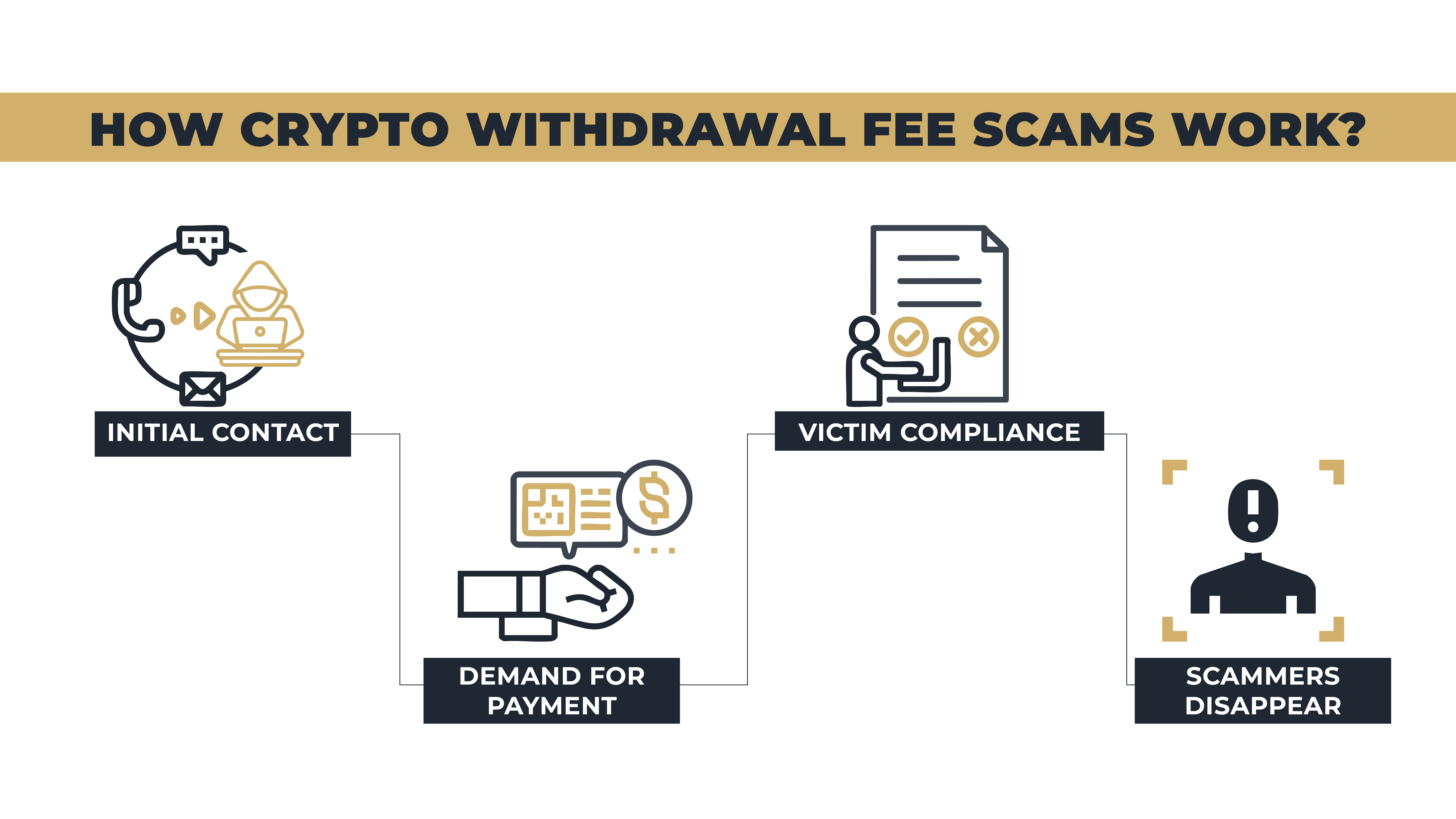
Although every scam is different, most crypto withdrawal fee scams follow the same pattern. Understanding how these scams unfold can make it easier to recognize them before more money is lost.
Step 1: A Fake Investment Opportunity
The scam often begins with an investment recommendation shared through social media, WhatsApp, Telegram, dating apps, or online investment groups. The platform looks professional, customer support is responsive, and the promised returns appear attractive enough to encourage an initial deposit.
Step 2: Your Account Shows Growing Profits
After you invest, your account dashboard begins showing impressive returns. In reality, these profits are simply numbers displayed on a fake platform. Some scammers even allow a small withdrawal early on to build trust and encourage larger investments.
Step 3: You Invest More Money
As the balance in your account continues to grow, the platform appears more trustworthy. Seeing what looks like steady profits encourages many people to invest larger amounts, believing they are building a successful investment and that the opportunity is genuine.
Step 4: Your Withdrawal Is Blocked
The scam usually becomes clear when you try to withdraw a larger amount. Instead of receiving your money, the platform claims your request cannot be processed until you pay taxes, verification fees, or meet other unexpected requirements that were never mentioned before.
Step 5: You Are Asked to Pay Additional Fees
The platform claims you must first pay a withdrawal tax, AML compliance fee, wallet verification fee, blockchain processing fee, or another mandatory charge. Once that payment is made, another requirement suddenly appears. Each new payment is presented as the final step before your funds are released, but the withdrawal never happens.
Step 6: The Platform Stops Responding
Eventually, customer support becomes difficult to reach, your account may be locked, or the website disappears altogether. By this stage, both your original investment and every additional payment have usually been lost.
While the names of these fees may change, the goal is always the same—to convince victims to keep sending more cryptocurrency. As these scams have become more sophisticated, scammers are finding new ways to make their demands appear legitimate, which is one reason they have become far more common in recent years.
Why Crypto Withdrawal Fee Scams Are on the Rise
Crypto withdrawal fee scams have become more convincing than ever. Instead of relying on poorly designed websites or obvious warning signs, scammers now use professional-looking platforms, advanced technology, and carefully planned tactics to gain people's trust.
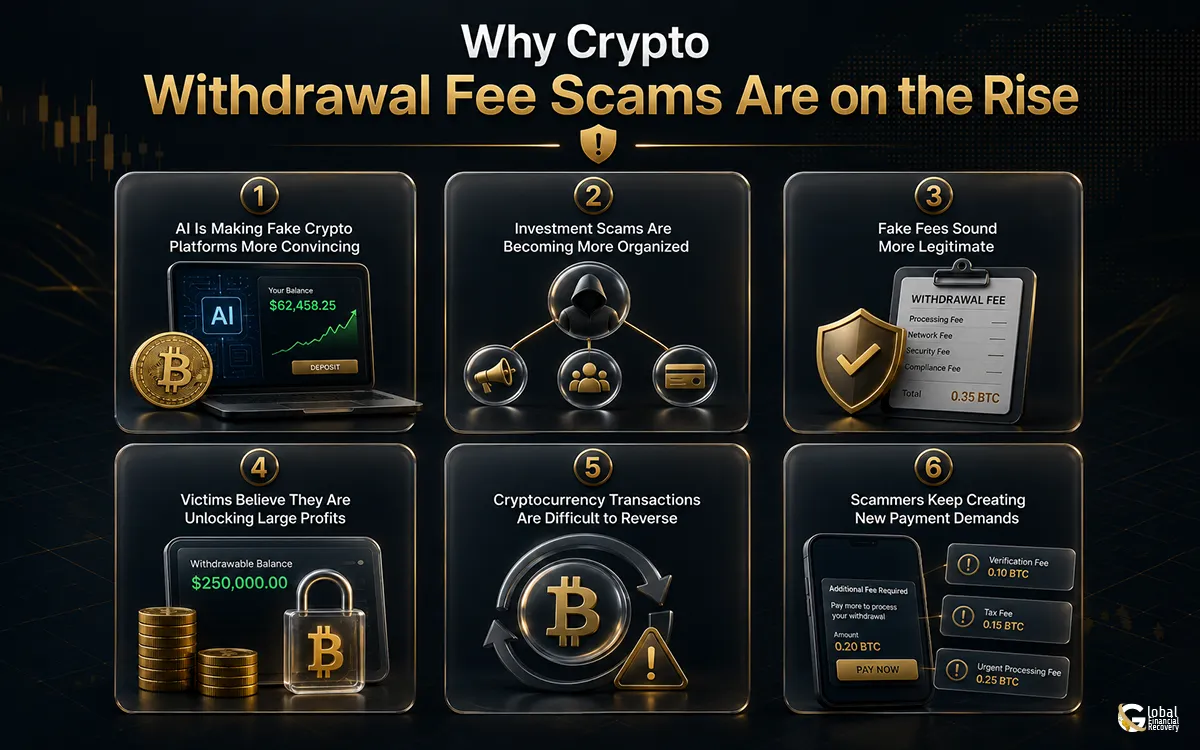
Several factors are driving this rise.
-
AI Is Making Fake Crypto Platforms More Convincing
Artificial intelligence allows scammers to quickly create realistic investment websites, fake customer support chats, convincing emails, and even fabricated reviews. These professional-looking platforms can closely resemble legitimate cryptocurrency exchanges, making them much harder to identify.
-
Investment Scams Are Becoming More Organized
Many scams no longer begin on fake websites. Instead, victims are first approached through social media, messaging apps like WhatsApp or Telegram, online communities, or even romance scams. By the time the fake investment platform is introduced, trust has already been established.
-
Fake Fees Sound More Legitimate
Rather than asking for a simple withdrawal fee, scammers now use official-sounding terms such as withdrawal tax, AML compliance fee, crypto verification fee, or wallet activation fee. These names are designed to make the payment appear like a normal regulatory requirement.
-
Victims Believe They Are Unlocking Large Profits
When an account displays thousands of dollars in unrealized profits, paying a smaller fee can seem like a reasonable trade-off. Scammers exploit this mindset by making the payment appear to be the final step before the funds are released.
-
Cryptocurrency Transactions Are Difficult to Reverse
Unlike many traditional banking transactions, cryptocurrency transfers are generally irreversible once confirmed on the blockchain. This makes crypto an attractive payment method for scammers and makes it more difficult for victims to recover funds after sending additional payments.
-
Scammers Keep Creating New Payment Demands
Many fraudulent platforms no longer stop after requesting one fee. Once a victim pays, scammers simply invent another reason why the withdrawal cannot be completed, creating an ongoing cycle of fake taxes, compliance checks, verification requests, and security deposits.
As these scams continue to evolve, the warning signs are becoming more important than ever. Fortunately, most fake withdrawal requests follow similar patterns. Learning to recognize those red flags early can help prevent additional losses; the next section covers the most common warning signs to watch for.
Red Flags of a Crypto Withdrawal Fee Scam
While every scam is different, most follow similar patterns. Recognizing these warning signs early can help prevent further financial loss.
Watch for these common red flags:
- You're asked to pay a tax before your cryptocurrency can be withdrawn.
- The platform requests an AML compliance fee or verification fee that must be paid separately.
- Customer support insists the fee cannot be deducted from your existing account balance.
- Your wallet or account is suddenly described as "frozen" until another payment is made.
- A new fee appears every time you've already paid the previous one.
- You're pressured to make the payment immediately to avoid losing your funds.
- The platform cannot provide any official documentation explaining why the payment is legally required.
- Your withdrawal amount keeps changing after each payment request.
- Customer support only communicates through chat apps or email and offers no verified phone support.
- Your account becomes restricted or inaccessible after you question the fees or refuse to pay.
One warning sign alone does not always confirm a scam. However, when several of these situations occur together, there is a much higher chance that you're dealing with a fake crypto platform rather than a legitimate cryptocurrency exchange.
These scams have affected thousands of investors worldwide, with some victims losing not only their original investment but also multiple additional payments made in the hope of unlocking their funds.
How Legitimate Crypto Exchanges Differ From Fake Crypto Platforms
At first glance, a fake crypto platform can look almost identical to a legitimate cryptocurrency exchange. The website may appear professional, customer support may respond quickly, and your account may even show impressive profits.
The difference usually becomes clear when you try to withdraw your funds.
Legitimate cryptocurrency exchanges have transparent processes for deposits, trading, and withdrawals. Fraudulent platforms, on the other hand, create unnecessary obstacles designed to convince users to send more cryptocurrency.
The comparison below highlights some of the biggest differences.
|
Legitimate Crypto Exchange |
Fake Crypto Platform |
|
Deducts trading or withdrawal fees directly from your account balance. |
Demands that you send additional cryptocurrency before your funds can be released. |
|
Does not promise guaranteed or unusually high investment returns. |
Displays unrealistic profits to encourage larger deposits. |
|
Does not ask customers to pay taxes by transferring cryptocurrency to a private wallet. |
Requests withdrawal taxes, AML fees, or compliance charges before approving withdrawals. |
|
Explains fees and policies clearly through official documentation and customer support. |
Provides vague explanations and keeps changing the reason your withdrawal is delayed. |
|
Operates with transparent business information and verifiable regulatory status where applicable. |
Avoids providing verifiable company information or makes false claims about regulation. |
|
Processes legitimate withdrawals according to its published policies. |
Introduces new fees or requirements each time a payment is made. |
No cryptocurrency exchange is completely risk-free, and every platform has its own fees and verification requirements. However, legitimate exchanges do not keep asking customers to send additional cryptocurrency just to access money that already belongs to them.
If a platform repeatedly blocks your withdrawal, demands payments to unlock your account, or keeps introducing new fees after each payment, it's important to question whether you're dealing with a fake crypto platform rather than a legitimate exchange.
Understanding these differences makes it much easier to recognize the warning signs early. In the next section, we'll look at some of the most common red flags that indicate a crypto withdrawal fee scam is already in progress.
A Recent Example of a Crypto Withdrawal Fee Scam
Crypto withdrawal fee scams continue to cause significant financial losses because they are designed to keep victims paying long after the initial investment.
According to the latest ‘scam alert’ released by the Australian Securities and Investments Commission (ASIC), there is a growing number of cryptocurrency investment scams in which victims are directed to fake trading platforms through social media and messaging apps. After showing large profits on their accounts, the platforms refused to process withdrawals until victims paid additional charges described as taxes, verification fees, or compliance costs. Many people paid these demands believing they were legitimate, only to face new payment requests or lose access to their accounts altogether.
Cases like these highlight an important pattern. The initial investment is often only the beginning. The biggest losses frequently occur after victims believe they are about to receive their profits and continue paying one fee after another in an attempt to complete the withdrawal.
Before looking at what to do after paying a fake withdrawal fee, it's worth understanding how these scams can often be avoided. While scammers continue to change their tactics, many of the warning signs remain the same. A few careful checks before investing or sending additional cryptocurrency can help prevent unnecessary losses.
How to Avoid Crypto Withdrawal Fee Scams
Crypto withdrawal fee scams often rely on trust, urgency, and convincing-looking platforms. Following a few basic precautions can make these scams much easier to identify before additional money is lost.
- Research the platform before investing: Verify reviews, company details, and reports of withdrawal issues through independent sources.
- Check the website carefully: Confirm the domain name, company information, and any available registration or licensing details.
- Never pay extra to unlock your funds: Legitimate exchanges usually deduct fees from your account balance rather than requesting separate crypto payments.
- Test withdrawals early: Make a small withdrawal before investing larger amounts to confirm the platform processes withdrawals properly.
- Be cautious of unsolicited investment offers: Opportunities shared through social media, Telegram, WhatsApp, dating apps, or online groups deserve extra scrutiny.
- Don't rush decisions: Pressure to pay immediately or risk losing your funds is a common scam tactic. Take time to verify every request before sending money.
No precaution is foolproof, but verifying platforms, questioning unexpected payment requests, and avoiding rushed decisions can greatly reduce the risk of becoming a target of a crypto withdrawal fee scam.
What to Do Immediately After Paying a Fake Withdrawal Fee
Paying a fake withdrawal fee can be stressful, but the steps taken immediately afterward can make an important difference. The priority is to prevent further losses while preserving as much evidence as possible.
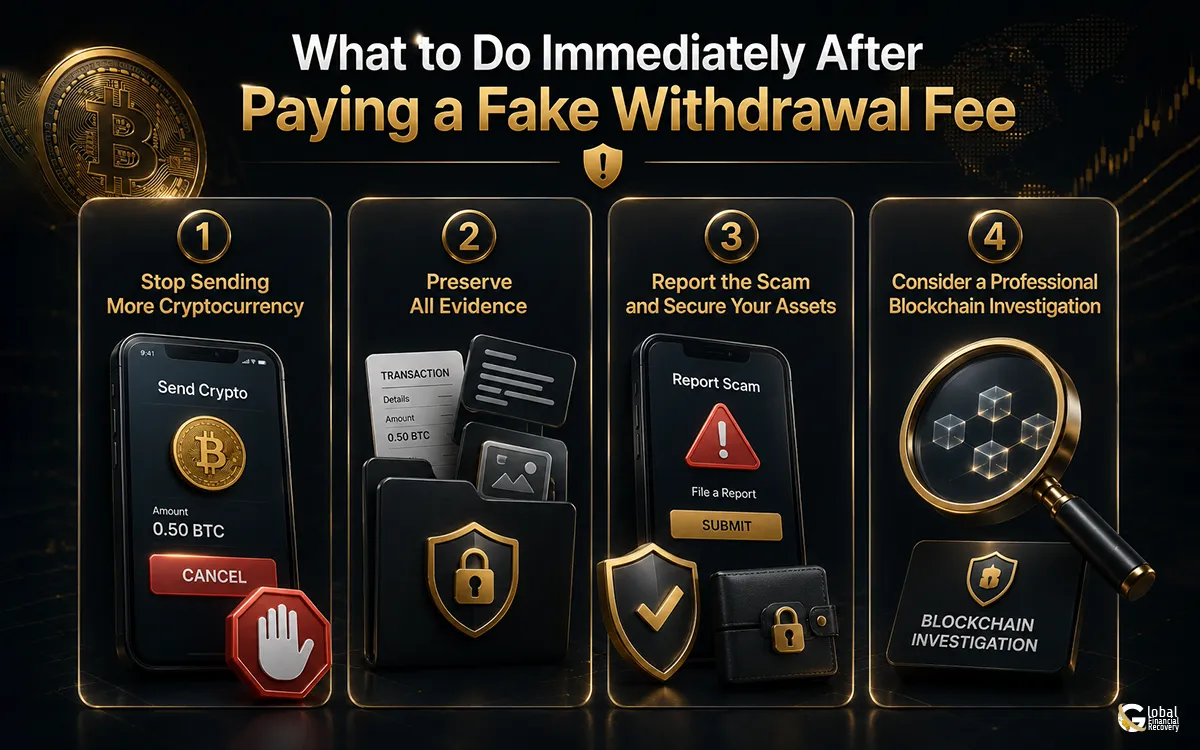
- Stop Sending More Cryptocurrency
No legitimate platform requires repeated payments to release your funds. Once withdrawal fees keep increasing, stop sending money immediately to avoid further losses.
- Preserve All Evidence
Save wallet addresses, transaction IDs (TXIDs), screenshots, payment receipts, withdrawal requests, and all communications with the platform. These records are essential for reporting and investigating the scam.
- Report the Scam and Secure Your Assets
Report the fraudulent platform to the relevant authorities and any cryptocurrency exchanges involved. Secure your remaining crypto by updating passwords, enabling two-factor authentication, and transferring assets to a trusted wallet when appropriate.
- Consider a Professional Blockchain Investigation
Blockchain transactions can often be traced to understand where funds were sent. A cryptocurrency investigation can help analyze the evidence, identify transaction patterns, and explain the realistic options available based on your case.
At Global Financial Recovery, we help individuals affected by cryptocurrency scams by reviewing transaction records, analyzing blockchain activity, and preserving evidence that may support recovery efforts.
Stay Alert Before You Send Another Payment
A fake withdrawal fee is rarely the last payment a scammer will ask for. Once one fee is paid, another often follows, making it easy to lose far more than the original investment.
The most important step is recognizing the pattern early. Legitimate cryptocurrency exchanges don't require customers to keep sending additional crypto to unlock their own funds. Taking a moment to question unexpected payment requests can prevent a difficult situation from becoming even worse.
When there's uncertainty about whether a platform is legitimate or a withdrawal request is part of a scam, getting an independent review can provide valuable clarity. At Global Financial Recovery, we begin with a free case evaluation, review the information you provide, and explain the recovery process in clear, straightforward language. Whether your case can move forward or not, our goal is to help you make an informed decision based on facts, not false promises.
Concerned that a withdrawal fee request may be part of a scam? Contact our team for a confidential case review and guidance on the next steps based on your specific circumstances.
FAQs (Frequently Asked Questions)
A crypto withdrawal fee is likely a scam if the platform asks for additional payments before releasing your funds. Common excuses include taxes, account verification, security deposits, or wallet activation fees. Legitimate cryptocurrency exchanges usually deduct any applicable fees directly from your account balance instead of asking for separate payments.
Stop making additional payments immediately, even if the platform promises your funds will be released after one more fee. Save transaction records, wallet addresses, screenshots, and all communication with the platform. Reporting the incident quickly and preserving evidence can improve the chances of tracing what happened.
Reputable cryptocurrency exchanges may charge withdrawal fees, but these are typically deducted automatically from the amount being withdrawn. They do not require users to send cryptocurrency or make separate payments to unlock an account or process a withdrawal request.
Crypto withdrawal fee scams are designed to convince victims that each payment is the final step before their funds are released. Once one fee is paid, scammers often invent new charges, such as compliance checks, insurance costs, or tax payments, to keep the scheme going for as long as possible.
Recovering cryptocurrency after a withdrawal fee scam can be difficult because blockchain transactions are generally irreversible. However, it is still important to act quickly by preserving evidence, reporting the incident, and having the wallet transactions reviewed. In some cases, blockchain analysis can help trace the movement of funds and support further investigation.
Book A Free Consultation
Recent Posts




From case evaluation to financial investigation, Global Financial Recovery provides transparent guidance to help you understand your case and explore your options.