
WhatsApp and Telegram Investment Scams: How Fake Trading Groups Steal Money
- Investments
- Updated On: October 5, 2026
Table of Contents
Most WhatsApp and Telegram investment scams will not start with a clear indication that it's a scam. In most instances, the interaction can be kicked off by something as simple as idle chat, an unsolicited text message, or an invitation into a chat where others are exchanging ideas regarding investments, cryptocurrency, or trading strategies.
Scammers can pull this off easily on messaging apps because it offers them a chance to slowly build up their trust and create what appears to be an honest group of traders/investors within a chat channel. The chat groups will feature pictures of successful trading and screenshots of gains made from the trading experience.
The Federal Trade Commission, also stated that consumer losses attributed to investment schemes amounted to over $5.7 billion during the year 2024, with many scams emerging from social media and messaging applications.
Another reason why these scams can be so effective is that they do not necessarily involve cyber hacks. The scams rather depend on psychological manipulation through emotional stress and fake trust built by the interaction in the online space. By the time victims realize they are stuck in an investment scam, they may already have sent significant amounts of money.
A proper understanding of how these scams work, the red flags, and their techniques will allow recognizing their fraudulent nature beforehand.
How WhatsApp and Telegram Investment Scams Work
Most WhatsApp and Telegram investment scams do not happen all of a sudden. Rather, such fraud happens through a step-by-step process. Initially, the scammer engages the victim in a conversation or through some form of social media engagement.
In most cases, the initial stage of a scam involves inviting the victim to join an investment community. This phase is mostly characterized by nothing out of the ordinary as members discuss trading strategies, market trends, successful investments, and share proof of success through screenshots.
In many cases, these are part of larger fake investment group scams designed to create artificial trust and social proof before victims are encouraged to invest money.
After a few days, the victims are persuaded to invest a relatively small amount in an apparently straightforward process. In some cases, the scammer allows some withdrawal of small amounts to show that the platform works.
Later on, more pressure is put on the victim to invest larger amounts of money for greater rewards. Scammers tend to create urgency in the minds of their victims by making them believe they are missing out on opportunities due to the rise in crypto markets.
The problem usually begins when someone tries to withdraw their funds. Suddenly, there may be unexpected taxes, verification fees, or account restrictions that require additional payments. By this stage, many victims have already invested significant amounts of money and are emotionally committed to recovering their funds.
Because the scam develops gradually, many people do not realize what is happening until communication stops or the fake platform disappears completely.
Common Warning Signs of a Fake Crypto Investment Platform
Because these scams are designed to look convincing, the warning signs are not always obvious in the beginning. However, many WhatsApp and Telegram investment scams share similar patterns that can help people recognize suspicious behavior before larger financial losses occur.
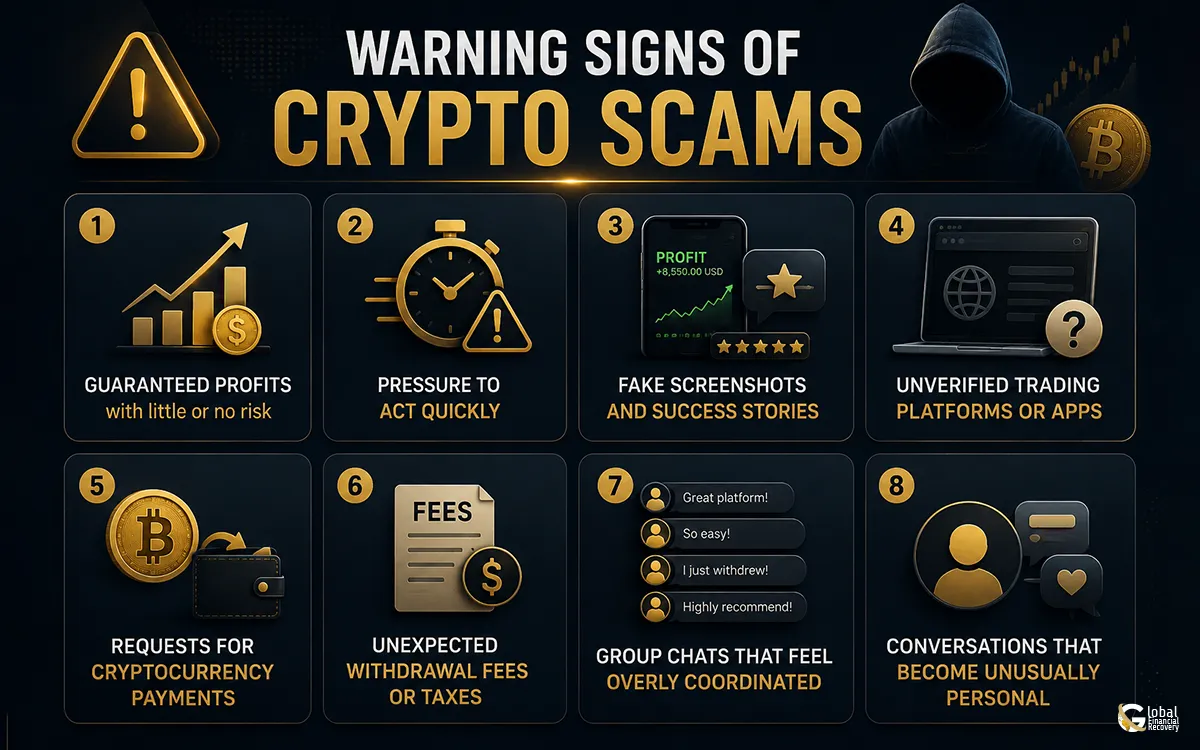
Some of the most common red flags include:
- Guaranteed profits with little or no risk
Investments that provide guaranteed profits and have no risks are an obvious sign of fraud. There is no way an investment is safe from risks. - Pressure to act quickly
Scammers usually create an aura of urgency and claim there is a limited number of opportunities to profit from their offer. - Fake screenshots and success stories
Most scam groups consist of fabricated screenshots of successful investments along with success stories that serve to legitimize an investment scheme. - Unverified trading platforms or apps
Victims are encouraged to use some websites or apps that show unreal amounts of money and manipulated profits. - Requests for cryptocurrency payments
It seems like scammers usually prefer crypto transfers since such transactions are harder to track or undo. - Unexpected withdrawal fees or taxes
Requesting extra money in order to release funds is among the surefire signs of fraudulent activities. - Group chats that feel overly coordinated
One of the ways scammers work within investment groups is by coordinating the answers among different group members to convince others to trust them. - Conversations that become unusually personal
Some scammers engage in conversation with victims and try to build trust before promoting their business offers.
Recognizing these warning signs early can make it easier to avoid becoming financially and emotionally involved in the scam. However, many victims only realize what happened after they attempt to withdraw money or lose contact with the scammers completely.
Looking at a real-world example can help show how these scams often unfold in practice and why they can appear convincing at first.
A Real Example of How These Scams Affect Victims
In 2024, a retired woman in the United States lost more than $400,000 after being added to a WhatsApp investment group that promised high returns through cryptocurrency trading. According to federal investigators, the group appeared professional and active, with members regularly sharing screenshots of profits and encouraging larger investments. Over time, the victim was convinced to transfer substantial amounts of money to what she believed was a legitimate trading platform.
At first, the account showed growing profits, which made the investment appear real. But when she attempted to withdraw her money, she was told additional payments were needed for taxes and verification fees. Eventually, communication stopped, and the platform became inaccessible.
Cases like this show how scammers use trust, fake community activity, and emotional pressure to make fraudulent investment schemes feel believable, even to cautious individuals.
While the financial losses in these scams can be devastating, the tactics behind them are often just as important to understand. Many scammers rely less on technical hacking and more on psychological manipulation to gain trust and influence decisions.
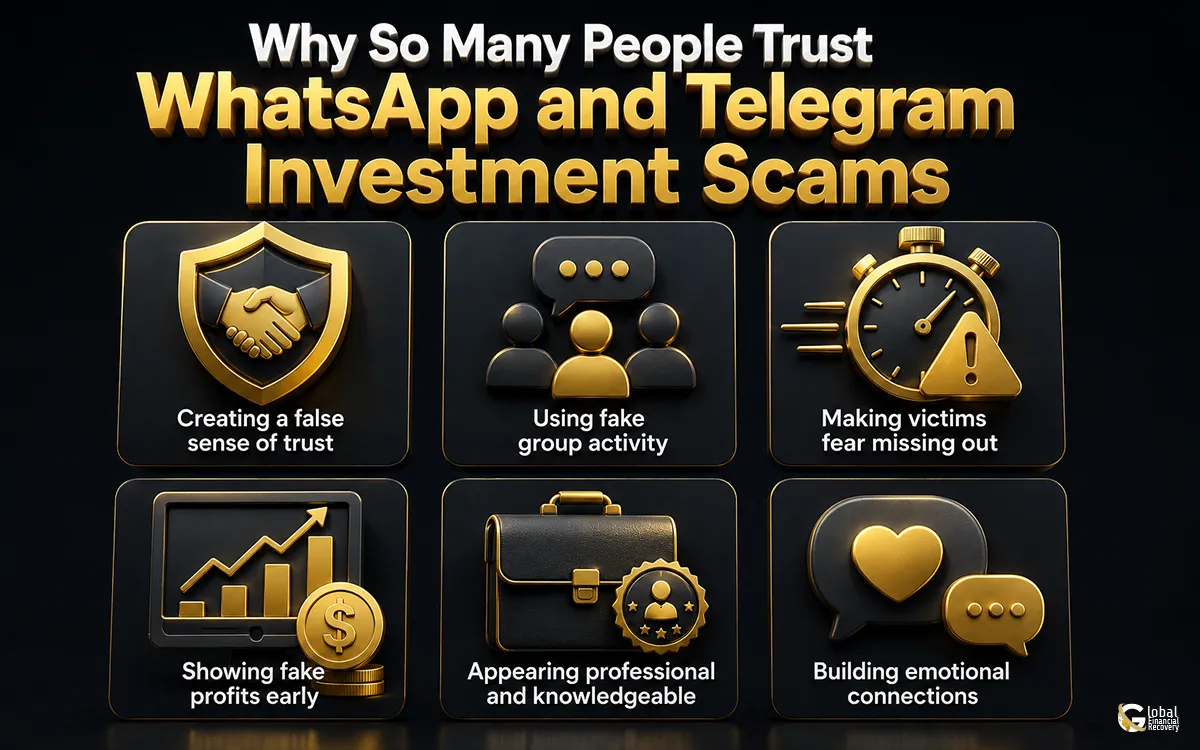
Why So Many People Trust WhatsApp and Telegram Investment Scams
Learn How Scammers Build Trust and Influence Decisions
- Creating a false sense of trust
Scammers often act friendly, helpful, and patient. Instead of asking for money immediately, they may spend days or weeks building conversations and making victims feel comfortable. - Using fake group activity
Many investment groups are filled with fake accounts controlled by scammers. These accounts post profit screenshots, success stories, and positive comments to make the opportunity appear real and popular. - Making victims fear missing out
Scammers frequently create urgency around “limited-time” opportunities or fast-moving markets to pressure victims into making quick decisions without thinking carefully. - Showing fake profits early
Some fake platforms allow small withdrawals or display fake returns in the beginning to build confidence and encourage larger investments later. - Appearing professional and knowledgeable
Scammers may use trading charts, financial terms, fake customer support teams, and professionally designed apps or websites to appear legitimate. - Building emotional connections
In some cases, scammers develop personal or romantic relationships before introducing investment opportunities, making victims more likely to trust their advice.
These tactics are commonly used in social engineering scams because they influence emotions and decision-making rather than relying on obvious threats. As online investment scams continue to evolve, understanding how scammers build trust can help people recognize suspicious behavior before larger financial losses occur.
What To Do If You Have Been Scammed
Discovering that you may have been targeted by an investment scam can feel overwhelming, especially when money has already been sent. Acting quickly can help limit further financial damage and improve the chances of preserving important evidence.
Let’s learn the steps to take after a WhatsApp or Telegram investment scam.
- Stop sending money immediately
Even if the scammers promise your funds can still be recovered, avoid making additional payments for taxes, verification charges, or withdrawal fees.
- Save all conversations and transaction records
Take screenshots of chats, group messages, wallet addresses, payment confirmations, emails, and trading platform details before anything is deleted or becomes inaccessible.
- Contact your bank or payment provider
If the payment was made through a bank transfer, debit card, credit card, or crypto exchange, report the transaction as soon as possible. In some situations, fast reporting may help limit losses.
- Secure your accounts and devices
Change passwords for email accounts, banking apps, crypto wallets, and any platforms connected to the scam. Enabling two-factor authentication can also help improve security.
- Report the scam to the authorities
Victims in the United States can report investment scams to agencies such as the Federal Trade Commission, the Federal Bureau of Investigation Internet Crime Complaint Center (IC3), and local law enforcement.
- Be cautious of recovery scams
After a scam, victims are often contacted again by people claiming they can recover lost money for an upfront fee. Many of these are additional scams targeting previous victims.
- Consider speaking with a professional recovery service
In some cases, victims choose to consult financial fraud recovery professionals who understand cryptocurrency tracing, scam investigation processes, and evidence preservation. When considering legitimate investment recovery services, look for providers that clearly explain their investigation process, fees, evidence requirements, and what they can realistically establish about a case. Services such as Global Financial Recovery may help victims better understand possible next steps after an investment scam.
Recovering from an investment scam can take time, but acting quickly, preserving evidence, and seeking reliable guidance can make an important difference moving forward.
When Trust Is Used as a Weapon
Scams that use WhatsApp or Telegram will continue to change because they take advantage of something almost everyone depends upon daily: communication, trust, and relationship-building. The worst part of investment scams that use WhatsApp or Telegram is how convincing and personal the whole experience is when it happens.
Creating a fake community of investors and using a simulated trading platform are techniques that can create credibility and reduce doubt throughout the process. Understanding the process behind such scams and being able to identify the early signs could help people to be smarter about what happens online.
If a person has already suffered a loss as a result of fraud, taking quick action and gathering evidence are some steps that they can consider. Being able to obtain credible information and receive professional advice might be beneficial for a victim as well.
If you believe you may have been targeted by a WhatsApp or Telegram investment scam, guidance from Global Financial Recovery can help you explore possible next steps and learn more about responding to financial fraud. Get help now with a free case evaluation and understand your recovery options.
FAQs (Frequently Asked Questions)
Some investment groups may be legitimate, but scammers often use WhatsApp and Telegram to run fake trading and crypto investment schemes. Be cautious of groups that promise guaranteed profits, pressure you to invest quickly, or ask for cryptocurrency payments through unknown platforms.
Scammers use messaging apps because they can contact victims directly, build trust over time, and create fake group activity that looks real. Private chats, large group features, and anonymous accounts also make these scams harder to detect.
Common red flags include guaranteed returns, fake profit screenshots, pressure to act fast, requests for crypto payments, and unexpected withdrawal fees. Many scam groups also use fake accounts to post success stories and make the investment appear legitimate.
In some cases, recovery may be possible depending on how the payment was made and how quickly the scam is reported. Victims should save all conversations, transaction records, wallet addresses, and screenshots before contacting their bank, crypto exchange, or relevant authorities.
Stop sending money immediately and save all evidence related to the scam, including messages, payment confirmations, and account details. You should also secure your accounts, report the fraud, and stay alert for recovery scammers who may contact victims after financial losses.
Book A Free Consultation
Recent Posts


From case evaluation to financial investigation, Global Financial Recovery provides transparent guidance to help you understand your case and explore your options.