
How Does Global Financial Recovery Work? A Look Inside Our Investigation Process
- Cryptocurrency
- Updated On: October 6, 2026
Table of Contents
Losing money to a scam can leave you unsure about what to do next. You may know that something went wrong, but not where your money went, what information matters, or whether you can still recover lost funds.
A fund recovery process starts with understanding the financial loss. This means looking at how the scam happened, how the money was sent, and what records are still available. Depending on the case, this may involve bank or payment records, account details, messages, platform information, or cryptocurrency transactions.
For a crypto scam, the investigation may also involve blockchain transaction tracing. Examining wallet addresses and transaction records can help establish how cryptocurrency moved after it was sent. Other types of financial loss may require different forms of financial investigation.
At Global Financial Recovery, we take an investigation-first approach to these cases. The process begins with a case evaluation and evidence review before moving into financial tracing and further investigation. Timing can also matter as records and other useful information may become harder to obtain as more time passes.
This guide explains how the scam recovery process works at Global Financial Recovery. What evidence is reviewed, how financial and blockchain tracing fits into an investigation, how timing can affect a case, and what you can realistically expect from the process.
How Does the Global Financial Recovery Process Work?
Recovering from a financial loss starts with understanding what happened and where the money went.
Our investigation process follows a structured path, from reviewing your case and evidence to tracing transactions and analyzing relevant information.
Each step helps build a clearer picture of the loss and the options that may be available based on the evidence.
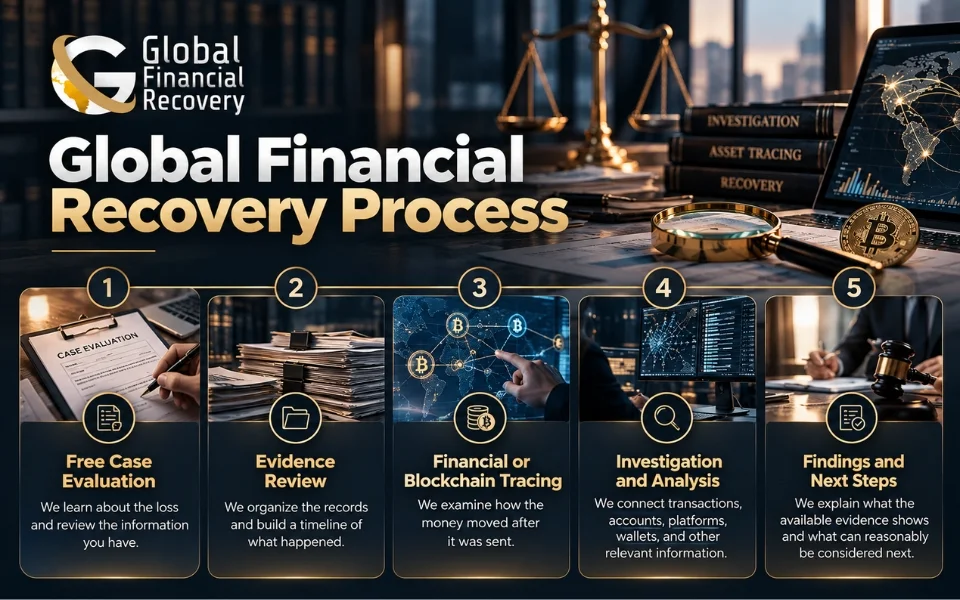
1. Free Case Evaluation
The first step is a free case evaluation. This is where we learn what happened and how the financial loss occurred. You may be asked about how the contact started, what you were promised, how payments were made, and what happened afterward.
The information available can include:
- Bank or payment records
- Cryptocurrency transaction IDs
- Wallet addresses
- Emails and messages
- Screenshots
- Website or platform details
- Account information
- Payment receipts
- Details about the person or company involved
You do not need to have every record before starting a case evaluation.
The first review helps identify what information is available and which parts of the case may need a closer look.
It is also important to understand what a case evaluation does not mean. It is not a promise that money will be recovered. It is the starting point for determining whether the financial loss can be investigated further.
2. Reviewing the Evidence
Once the basic details are understood, the available records can be organized. This often means putting payments, messages, account activity, and other events into the right order.
A clear timeline can answer questions such as:
- When did the scam begin?
- When was the first payment made?
- Who received the money?
- Were more payments made later?
- When did the person or platform stop responding?
- Were additional fees requested?
This can be especially important when a scam lasts for weeks or months.
For example, someone may have started with a small investment. The platform then showed growing profits and encouraged larger deposits. Later, the person may have been told that a tax, withdrawal fee or account charge was needed before the money could be released.
Looking at the records in order can show how the loss developed.
Why keeping old records matters
Do not delete messages, emails, screenshots, receipts, or account information after discovering a scam.
Websites can disappear. Accounts can be closed. Messages may become harder to access. The person behind the scam may also change phone numbers, email addresses, or usernames.
Older cases can still be reviewed, but having more original information can make it easier to understand what happened.
3. Tracing Where the Money Went
Once the transactions are understood, the investigation can focus on the movement of the money.
The method used depends on how the payment was made.
-
Bank and payment transactions
Traditional payments can leave records with banks, card providers, payment processors, exchanges, and other financial services.
Reviewing these records can help establish when a payment was made, where it was sent, and whether there were later transactions connected to it.
-
Cryptocurrency transactions
Crypto cases can involve blockchain transaction tracing. Public blockchains record cryptocurrency transactions. This allows our investigators to examine transaction histories and follow movements between wallet addresses.
For example, cryptocurrency sent to one wallet may later move to another wallet and then to several more addresses. Examining those transactions can help establish how the assets moved after the original payment.
Blockchain tracing can provide valuable information, but it has limits.
A wallet address does not automatically reveal the name of the person controlling it. Tracing cryptocurrency also does not guarantee that the assets can be returned.
The purpose of this stage is to understand the movement of the funds and identify information that may be relevant to the wider investigation.
4. Connecting the Different Pieces
Financial scams rarely involve just one transaction.
There may be a payment, a website, several messages, an investment account, a bank account, and one or more cryptocurrency wallets.
Each record can tell part of the story.
For example:
- A bank record can show when money was sent.
- A message can explain why the payment was made.
- A website can show how an investment was presented.
- An account screenshot can show what the person was told about their balance.
- A blockchain record can show where cryptocurrency moved afterward.
Looking at these records together can reveal connections that are difficult to see when each item is reviewed on its own.
It can also help separate what the records support from what someone simply claimed. This matters because scammers often make claims about profits, withdrawals, account balances, taxes, or fees that do not match the actual financial activity.
5. Reviewing the Investigation Findings
After the relevant information has been examined, the findings are reviewed as a whole.
This stage looks at:
- What the records confirm
- Where the money moved
- Which parts of the story can be supported
- What information is still missing
- Whether further investigation may be useful
Not every case produces the same findings.
Some cases may have detailed payment records and clear transaction histories. Others may have missing information or a more complicated financial trail.
The investigation therefore focuses on what can actually be established from the available evidence.
Global Financial Recovery does not promise a specific recovery amount or guaranteed result. The purpose of the investigation is to provide a realistic assessment based on the facts of the case.
How Timing Can Affect a Financial Investigation and Transaction Tracing
The timing of a financial investigation can matter, especially when the goal is to understand where funds moved after a scam. The sooner a loss is reported and the available records are preserved, the more information may remain available to examine.
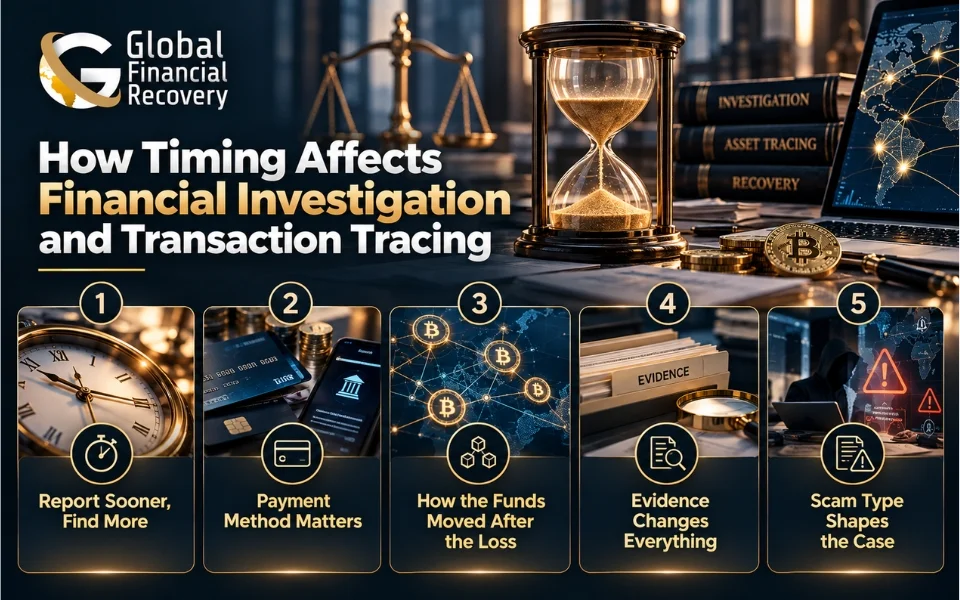
Several factors can affect what an investigation is able to establish and how much work may be required.
Report Sooner, Find More
Reporting a financial loss sooner can help preserve useful information. Banks, payment providers, cryptocurrency exchanges, and other services may have their own reporting or dispute timeframes. Scam websites may disappear, accounts may be closed, and messages or other records may become harder to access over time.
An older case can still be reviewed, but delays may affect what information is available and how clearly the movement of funds can be established.
Payment Method Matters
The payment method determines what records and transaction details can be examined. Bank transfers, card payments, wire transfers, and cryptocurrency transactions leave different types of financial records.
In cryptocurrency cases, blockchain transaction tracing can be used to follow transfers between wallet addresses. Traditional payment methods may require a review of bank records, payment providers, or other financial services.
How the Funds Moved After the Loss
Funds may move through multiple bank accounts, payment services, cryptocurrency wallets, exchanges, or other platforms after they are sent. When a financial trail involves several transactions or destinations, tracing and connecting those movements can require additional analysis.
Evidence Changes Everything
Transaction records, wallet addresses, payment confirmations, account details, emails, messages, screenshots, and platform information can help establish what happened. Missing or incomplete records can make parts of the financial trail harder to verify.
Scam Type Shapes the Case
Different scams leave different types of evidence. A cryptocurrency investment scam may require blockchain analysis, while a romance scam may involve extensive communications and payment records. Cases involving multiple payments, accounts, platforms, or payment methods may also require a broader review.
For these reasons, Global Financial Recovery does not promise a fixed investigation timeline. The initial case evaluation helps determine what happened, what information is available, and how much work may be required to examine the case.
How We Handle Your Information During an Investigation Process
Financial investigations can involve sensitive personal and financial information. Global Financial Recovery treats confidentiality as an important part of the investigation, from the initial case evaluation through the review of findings.
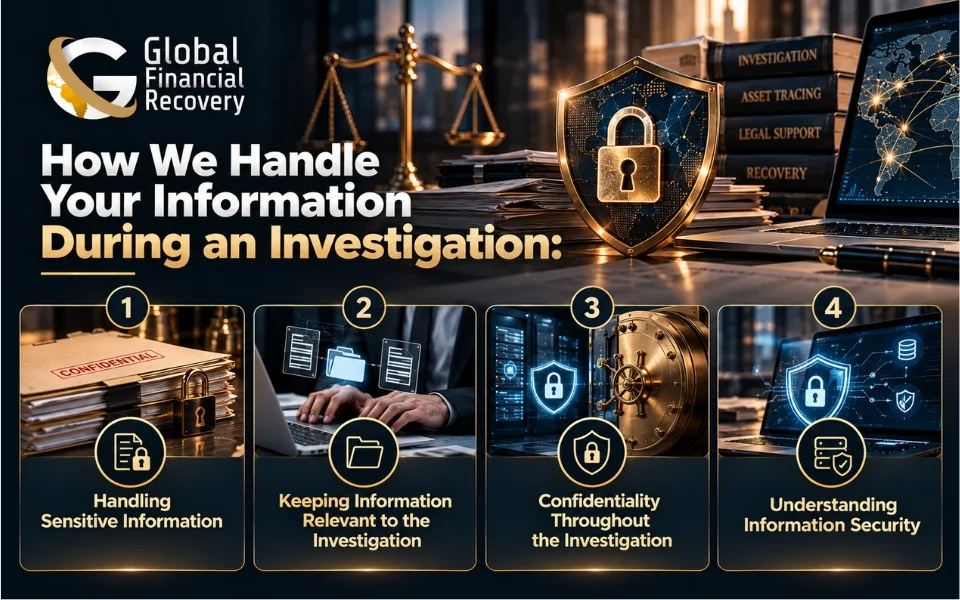
- Handling Sensitive Information: A case may involve financial records, account details, transaction information, communications, screenshots, and other documents related to the financial loss. These details are reviewed in the context of understanding and investigating the case.
- Keeping Information Relevant to the Investigation: Information provided during a case review helps establish what happened and identify relevant parts of the financial trail. Keeping the investigation focused also helps avoid unnecessary use of unrelated personal information.
- Confidentiality Throughout the Investigation: Protecting sensitive information remains important as records are reviewed, transactions are examined, and different pieces of evidence are connected. Confidentiality is therefore considered throughout the investigation rather than only at the initial stage.
- Understanding Information Security: For a more detailed explanation of how Global Financial Recovery approaches confidentiality and information security, see How Global Financial Recovery Protects Your Confidentiality and Security.
A Transparent Approach to Financial Recovery
Understanding how a financial investigation works can make the process easier to approach. There is no standard outcome for every case, and the ability to trace or investigate a financial loss depends on the circumstances, available evidence, payment method, movement of funds, and other factors.
When comparing legitimate fund recovery companies, look for providers that explain their investigation process clearly, review the available evidence, and are transparent about what can and cannot be established. A credible provider should avoid guaranteed recovery claims and clearly explain the potential limitations of your case.
Global Financial Recovery takes an investigation-first approach. The focus is on understanding what happened, examining the available evidence, tracing the financial trail where possible, and explaining what the findings show. Recovery is never presented as guaranteed, and no fixed result or timeline can be promised.
For someone who has lost money to a scam, the first step is often simply understanding what happened and what information is still available. A free case evaluation can provide a starting point for that review.
Request Your Free Case Evaluation to discuss your situation with Global Financial Recovery and understand what can reasonably be examined based on the information available.
FAQs (Frequently Asked Questions)
Stop sending additional money and preserve all records connected to the incident before deleting accounts, messages, or emails. Contact your bank, card provider, cryptocurrency exchange, or payment service as soon as possible to report the transaction and ask what options may still be available. Keep transaction IDs, wallet addresses, receipts, communications, screenshots, and account details together. Avoid paying anyone who promises guaranteed recovery.
A transfer to another account does not automatically mean the money cannot be investigated. The next steps depend on how the payment was made, where the funds were sent, whether further transactions can be identified, and what records are available. For cryptocurrency, blockchain records can help trace movements between wallet addresses. An investigation can determine what the available financial trail shows, but tracing funds does not guarantee that they can be returned.
Provide information that helps establish how the loss occurred and where the money was sent. Useful records can include payment receipts, bank or exchange transaction details, cryptocurrency wallet addresses, transaction IDs, emails, messages, website or platform information, account details, and communications with the person involved. Organizing these records in chronological order can also make it easier to understand the sequence of events.
It is generally better not to send more money or share additional personal or financial information with the scammer. Scammers may claim that another payment is needed for taxes, withdrawal fees, account verification, legal costs, or processing charges before funds can be released. Further payments can increase the financial loss without resolving the original problem. Preserve the communications instead, as they may contain useful information about the case.
Yes. People who have already lost money can be targeted again by individuals claiming to be recovery agents, investigators, lawyers, government officials, or representatives of financial institutions. Common warning signs include requests for upfront fees, cryptocurrency payments, account passwords, remote access, or guarantees that a specific amount will be recovered. A legitimate investigation should not require you to surrender control of your financial accounts or promise a guaranteed result.
Book A Free Consultation
Recent Posts


From case evaluation to financial investigation, Global Financial Recovery provides transparent guidance to help you understand your case and explore your options.