
Crypto Recovery Scams: How Fake Recovery Companies Target Victims Again
- Cryptocurrency
- Updated On: September 24, 2026
Table of Contents
Losing cryptocurrency is stressful enough. But what happens when someone suddenly contacts you and says they can get your money back?
That is where another scam can begin. Crypto recovery scams target people who have already lost money by pretending to offer professional recovery help. The person may claim to have found your funds, traced your wallet, or know exactly how to get your crypto back.
For someone who has already been through a crypto scam, hearing that there is a way to fix things can feel like a huge relief. You may be hoping for answers, trying to understand what happened, or simply looking for someone who can help. That can make a recovery offer feel especially convincing.
The FBI warns that cryptocurrency recovery scammers specifically target people who have already lost crypto to fraud or theft. These scammers may contact people through social media, messaging apps, online searches, or advertisements for recovery services.
This means the original scam may not always be the end of the danger. A person who has already lost money can become a target for a second scam, this time built around the promise of getting that money back.
In this article, we will help you understand how these scams work. Understanding the concept can help you recognize the warning signs before another promise, payment request, or message causes further loss.
What Is a Crypto Recovery Scam?
A crypto recovery scam is a second scam that happens after an original cryptocurrency loss. The scammer pretends to be a recovery expert and claims they can help return the lost funds.
They could reach out to you via mail, telephone, or online platforms such as social media or websites. They will use information from the first scam to give credibility to their claim.
Moreover, the aim is typically to obtain additional money or personal data from you.
How the Scam Usually Works
Crypto recovery scams often follow a similar pattern. Scammers first identify people who have already lost cryptocurrency, then use promises of recovery to build trust and request payments or sensitive information.
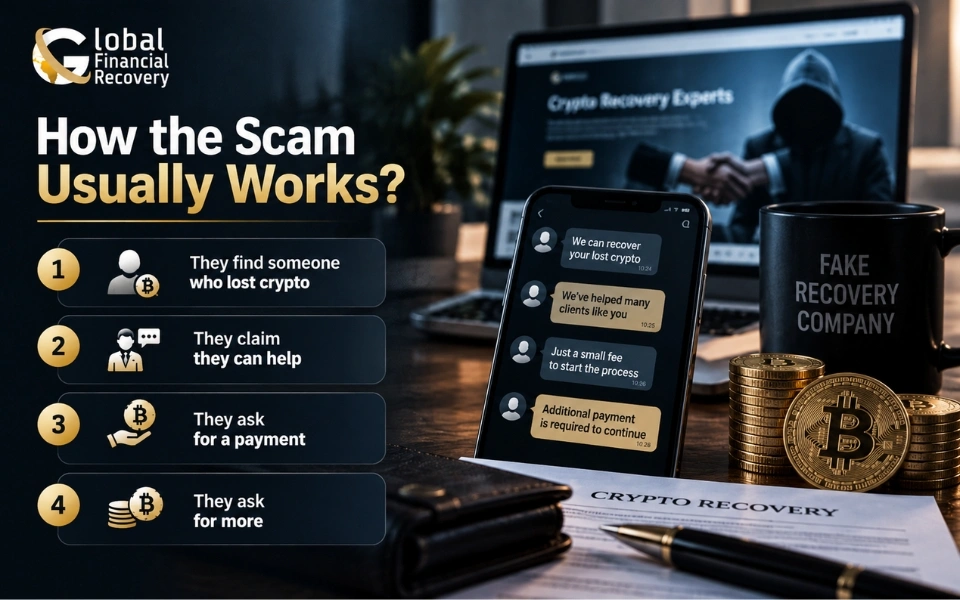
1. They find someone who lost crypto
Scammers look for people who have already reported a loss or are searching online for help. They may find information through social media, forums, websites, or other public sources.
2. They claim they can help
The scammer may say they have traced your funds, found your wallet, or have a special way to recover your cryptocurrency.
3. They ask for a payment
You may be told to pay a tax, release fee, verification charge, or processing fee before the funds can be returned.
4. They ask for more
After the first payment, another fee may appear. Some scammers also ask for passwords, private keys, seed phrases, or other sensitive information.
The story can sound convincing, especially when the person already knows details about your original loss. But knowing those details does not prove that they have found your money.
How to Spot and Avoid a Crypto Recovery Scam
A recovery scam can look very convincing at first. The website may appear professional, the person may know details about your loss, and the offer may sound like exactly what you have been looking for. However, with careful inspection, there are usually many signs of a scam that will make themselves evident.
|
Warning Sign |
How the Scam Works |
What You Should Do |
|
Guaranteed recovery |
The company promises 100% recovery or says your funds are already secured. |
Be careful with guarantees. Ask what evidence supports the claim and what can realistically be recovered. |
|
Unsolicited contact |
Someone contacts you without being asked and already knows about your crypto loss. |
Ask how they found you. Check the company independently instead of using the contact details they provide. |
|
Repeated fees |
You pay one fee, then another charge appears before the funds can supposedly be released. |
Stop and question every new payment request. Do not assume another payment will be the last one. |
|
Private wallet details |
The person asks for your seed phrase, private key, password, or security codes. |
Never share these details. They can give someone access to your wallet or accounts. |
|
Pressure to act quickly |
You are told that your funds will soon be lost or that you must pay immediately. |
Take time to verify the claim. A legitimate investigation should not depend on rushed decisions. |
|
Fake reports or documents |
Screenshots, blockchain reports, certificates, or case numbers are used to make the service look genuine. |
Check important claims through independent sources. A professional-looking document does not prove the claim is real. |
|
Crypto payment requests |
You are asked to send Bitcoin, Ethereum, USDT, or another cryptocurrency before the recovery work is completed. |
Ask why the payment is needed, where it is going, and what service it covers before paying. |
|
Funds are “already found” |
The person says they have located your crypto but need a fee to release or transfer it. |
Ask for clear evidence. Finding a transaction does not mean the funds can automatically be returned. |
Another trick that scammers use is to refer to a payment as the “final step” in order to retrieve your funds. After the payment is made, they will come up with another problem and request another payment from you, which could be a tax, a wallet fee, a verification fee, or a release fee.
This process may repeat itself multiple times, where every payment is described as the final one, until you make a payment and do not receive your money.
Pay special attention to frozen crypto wallet recovery schemes. You may be told that your wallet has been frozen and that you need to pay in order to unfreeze it. Ask them for reasons for freezing your wallet, evidence of the freeze, and the reason for requiring a payment to unlock your wallet.
What Does a Legitimate Recovery Investigation Look Like?
A legitimate investigation starts with the facts of the original loss. The first step is usually to review the available evidence, such as transaction records, wallet addresses, payment details, account information, emails, messages, and screenshots.
For cryptocurrency cases, blockchain analysis can help you trace transactions and follow the movement of funds between wallet addresses. Other records may help connect those transactions to a platform, account, or person involved in the
loss.
The purpose is to understand what happened and determine what the available evidence can show. An investigation is not the same as a promise that money will be recovered.
A trustworthy service should be willing to explain what is being reviewed, what has been found, and what cannot be confirmed. Be cautious when a service focuses more on guaranteed results and urgent payments than on the actual evidence.
What to Do If a Recovery Scam Has Targeted You
Being targeted by a recovery scam can feel especially painful because you were already trying to fix an earlier loss. You may feel angry, embarrassed, or unsure about what to do next.
Try not to blame yourself. Recovery scammers know that people who have lost money want answers. They use that hope and worry to make their promises sound believable. The most important thing now is to stop the second loss from getting worse.
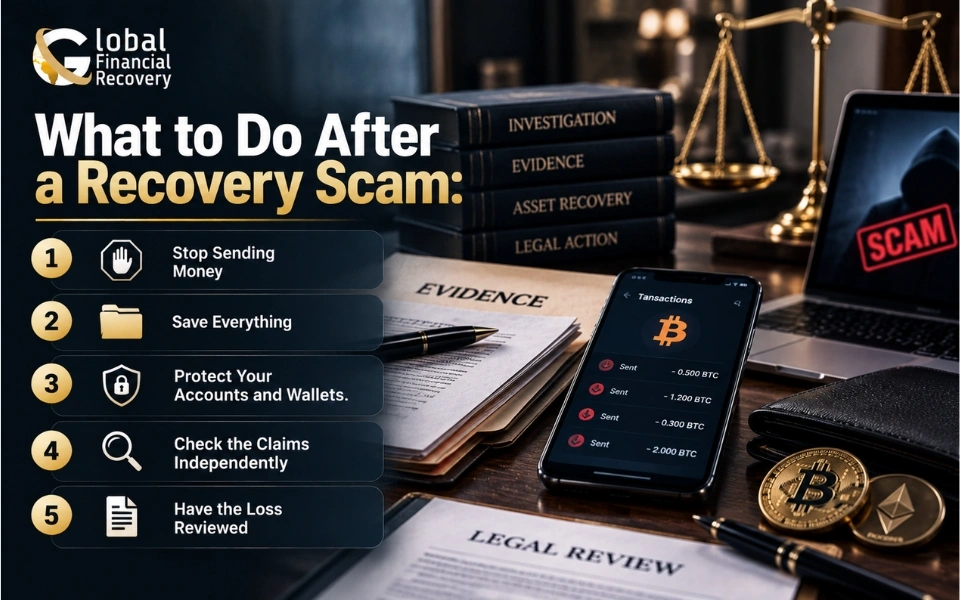
- Stop Sending Money
Do not send another payment because someone claims it is needed to release, verify, insure, or recover your funds. A scammer may introduce a new fee after every payment and make the next payment sound urgent.
If you have already paid a recovery scammer, stop further payments and keep a record of what you were asked to pay, when you paid it, and where the money was sent. This information may help when the case is reviewed.
- Save Everything
Keep as much information about the recovery scam as possible. Save emails, text messages, social media conversations, screenshots, payment receipts, invoices, wallet addresses, transaction IDs, phone numbers, email addresses, website URLs, and account details.
Do not delete conversations just because they are upsetting or embarrassing. Messages may show what the person promised, how they contacted you, what payments they requested, and which accounts or wallets were involved.
- Protect Your Accounts and Wallets
Do not share your seed phrase, private key, password, two-factor authentication code, or other security information with someone claiming to help recover your funds. A legitimate review of a crypto loss should not require you to hand over control of your wallet.
If you believe your account information has been exposed, change affected passwords and secure your accounts as soon as possible. Check for unfamiliar login activity, connected devices, or transactions that you do not recognise.
- Check the Claims Independently
Do not rely only on what the person contacting you tells you. Recovery scammers may use company names, fake websites, official-looking documents, or false claims about blockchain tracing to appear legitimate.
Take time to check the company's identity, contact details, website, registration information where applicable, and the claims being made. Be especially careful when someone promises guaranteed recovery, claims to have already located your funds, or pressures you to pay immediately.
- Have the Loss Reviewed
Once further payments have stopped and your records are secured, consider having the full situation reviewed. Looking at the original scam and the later recovery scam together can help show how the events are connected.
Global Financial Recovery can review available records, examine relevant transaction activity, and assess what the evidence may show. This can include information about payments, wallet addresses, communications, websites, and the people or platforms involved.
The goal should be to understand the case clearly and identify realistic next steps, rather than making another payment based on a promise.
Protect Yourself After a Recovery Scam
Losing cryptocurrency can leave you wanting to act as quickly as possible. That feeling is understandable. When someone then says they can fix everything, it can be hard to step back and question the offer.
But a recovery claim should never be trusted simply because it sounds professional or because the person knows details about your original loss.
Take time to check the company. Protect your wallet information. Save your records. Most importantly, look for evidence instead of promises.
When a crypto loss has already happened, understanding what happened to the funds is an important first step. Global Financial Recovery provides financial investigation and asset tracing support for complex financial losses.
FAQs (Frequently Asked Questions)
Recovery scammers may find victims through social media, forums, websites, online searches, or information shared publicly about the original crypto loss.
They may request taxes, release fees, verification charges, processing fees, wallet fees, or other payments before claiming they can return the funds.
They may describe each new payment as a final step, then introduce another supposed problem or fee after the victim pays.
No. Finding or tracing a transaction does not automatically mean the cryptocurrency can be returned. Evidence is needed to determine what happened to the funds.
Sharing a seed phrase or private key can give another person access to a cryptocurrency wallet. The article specifically advises victims not to provide these details to someone claiming to help with recovery.
Book A Free Consultation
Recent Posts




From case evaluation to financial investigation, Global Financial Recovery provides transparent guidance to help you understand your case and explore your options.