
Can You Recover Money Lost in a Pig-Butchering Investment Scam?

- Cryptocurrency
- Updated On: May 7, 2026
Table of Contents
It often becomes clear at the point when a withdrawal stops working.
Up until then, everything may have felt steady. The conversations were ongoing, the platform looked legitimate, and the numbers on the screen showed consistent growth. A level of trust was also built with the person guiding the investment, which made each step feel reasonable at the time.
This is how pig butchering investment scams usually unfold. The situation doesn’t feel like a typical scam, which is why it can take time to fully recognize what has happened. Many people don’t immediately recognize it as a scam, and even when they do, it can be difficult to know what to do next.
One of the first questions that comes up is whether the money can still be recovered.
Recent findings from the Federal Bureau of Investigation show that investment scams continue to account for the highest financial losses in cybercrime cases, with cryptocurrency playing a major role.
A growing number of these cases are linked to pig butchering scams, where funds are often moved across multiple wallets and platforms. This makes recovery more complex.
Recovery is possible in some cases, but it depends on several factors, including how the transactions were handled and how quickly action is taken. Understanding what affects those chances is an important first step. This blog focuses on pig butchering scam recovery, how it works, what can influence the outcome, and what steps can help you move forward with clarity.
Why is recovery in pig butchering scams complicated?
Recovery in pig butchering scams can be challenging because of how these scams are set up.
One of the biggest challenges in these cases is not just technical, it's personal. Because pig butchering scams are built on trust over time, realizing what has happened is not always immediate. It can feel confusing, and in many cases, difficult to accept. Some people try to resolve the situation on their own first or wait before reaching out, hoping there’s still a way to withdraw the funds.
This delay often has the biggest impact on recovery.
From a technical side, by the time action is taken, the funds are often moved across multiple cryptocurrency wallets, sometimes within a short span of time. These transactions can pass through several addresses or platforms, which makes it harder to trace where the money currently is and whether it is still within reach.
The platforms shown during the process can also add to the confusion. They often appear real but don’t reflect actual transactions, which delays recognizing the issue.
Recovery may still be possible, but it depends on both how quickly action is taken and how the funds were moved.
Is It Actually Possible to Recover Money?
In some cases, recovery is possible. But it depends on how the situation develops after the funds are sent and how quickly action is taken.
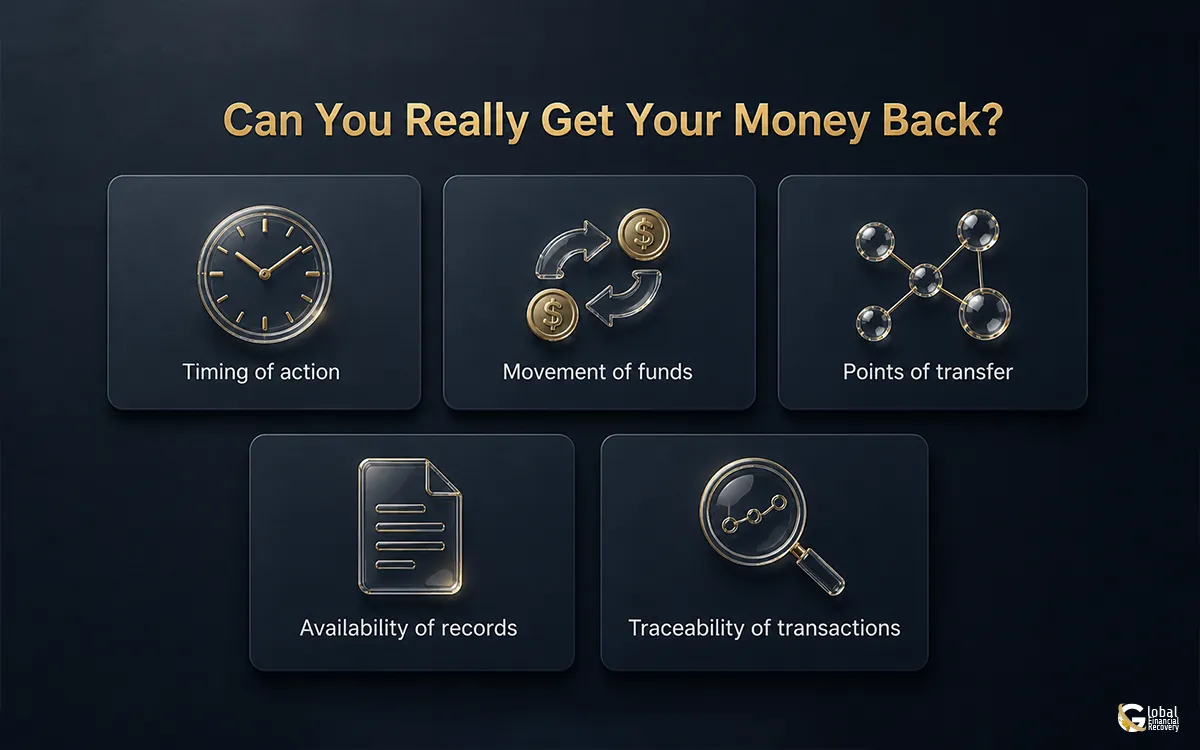
There isn’t a single outcome that applies to every case. In investment fraud recovery, a few key factors usually determine what can be done next:
-
Timing of action
The earlier the transactions are reviewed, the better the chances of tracing fund movement. Delays often make recovery more difficult.
-
Movement of funds
If the money has been moved across multiple wallets or split into smaller amounts, it becomes harder to track and follow.
-
Points of transfer
In some online investment scam recovery cases, funds may pass through identifiable platforms or exchanges, which can open up possible next steps.
-
Availability of records
Transaction IDs, wallet addresses, and communication history help build a clearer picture and support further analysis.
-
Traceability of transactions
Cryptocurrency transactions can often be tracked, but tracing alone does not guarantee recovery. It depends on where the funds are and whether they are still reachable.
Recovery is always case-dependent. The goal is to understand what is possible based on these factors and take informed steps from there.
How does pig butchering scam recovery work?
Recovery is not a single action. Basically, it’s a process that focuses on understanding where the money went and what can still be done.
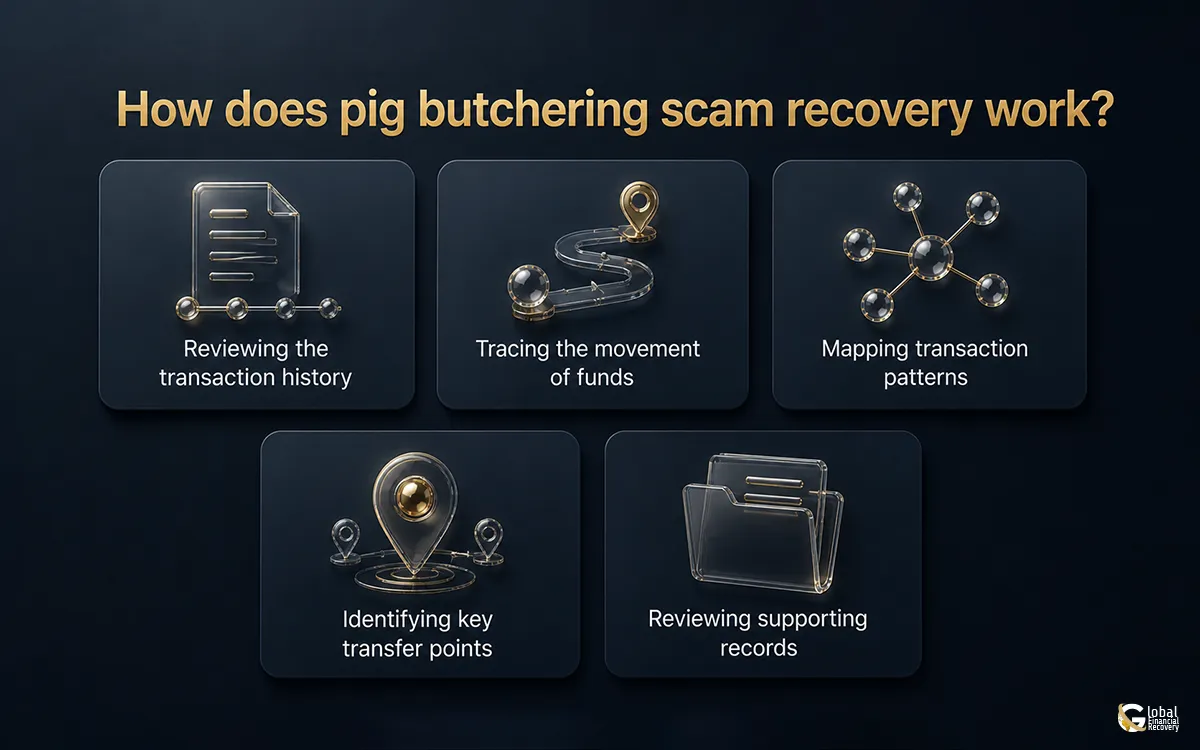
While each case is different, most pig butchering scam recovery efforts follow a similar set of steps:
Step 1: Reviewing the transaction history
The process starts by collecting and reviewing all transaction details, including wallet addresses, transaction IDs, and payment timelines. This helps build a clear picture of how the funds were sent.
Step 2: Tracing the movement of funds
Once the timeline is established, the next step is to trace how the funds moved across wallets. In many cases, transactions are followed from one address to another to understand the path taken.
Step 3: Mapping transaction patterns
Funds are often split, rerouted, or moved quickly across multiple wallets. Identifying these patterns helps in understanding how complex the movement is and where the trail leads.
Step 4: Identifying key transfer points
Some transactions may pass through platforms or exchanges. These points are important, as they can help determine whether any part of the funds is still traceable or potentially reachable.
Step 5: Reviewing supporting records
Communication history, payment confirmations, and platform details are analyzed alongside transaction data to strengthen the overall assessment.
This process is supported by blockchain intelligence, which helps trace transactions, analyze fund movement, and build a clearer understanding of where the money has gone.
Moreover, this does not guarantee recovery, but it helps clarify what is possible in each case and what steps can be taken next with a better understanding.
A Real Case Scenario
In one reported case highlighted by the Federal Bureau of Investigation, an individual was approached through a social platform and slowly built a connection over time. The conversations became regular, and eventually, the topic of investing came up.
They were introduced to a cryptocurrency platform that appeared legitimate and were guided through the process step by step. Initial investments showed steady returns, which built confidence. At one point, a small withdrawal was successful, making the platform feel even more reliable.
As the investment amount increased, so did the requests. The individual was asked to pay additional fees and taxes to unlock larger withdrawals. Each payment was presented as the final step.
Eventually, after sending a significant amount, communication stopped, and access to the platform was lost.
This pattern is consistent across many pig butchering scams. This example reflects how structured and convincing these scams can be, which is why many people only begin to question things when withdrawals fail.
At that point, the focus often shifts from understanding the scam to figuring out what can be done next, and that’s where recovery services usually come into the picture.
How Recovery Services Work (and Red Flags to Avoid)
After realizing what has happened, many people start looking for help. This is where investment scam recovery services come in, but not all services operate the same way.
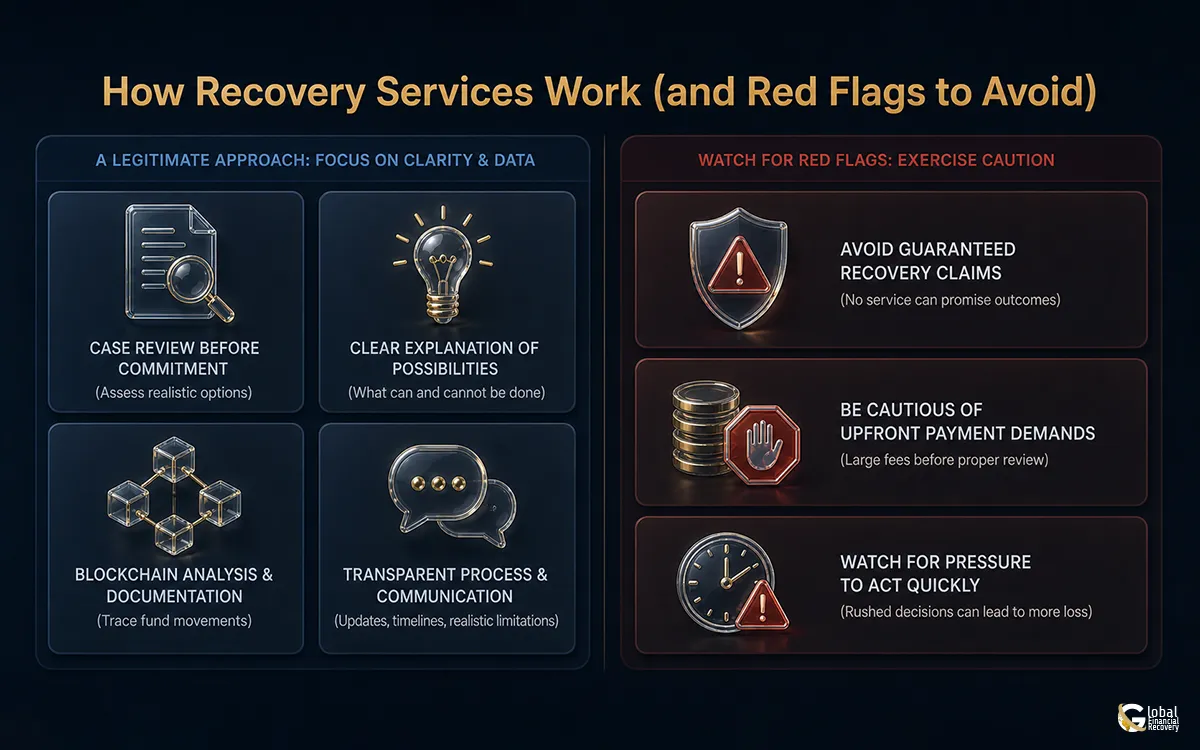
A legitimate approach usually starts with understanding the case, not making promises.
- Case review before any commitment
The first step is to assess what happened, how the funds were sent, where they may have moved, and whether recovery efforts are realistic. - Clear explanation of possibilities
A genuine service focuses on explaining what can and cannot be done, based on the details of the case. The goal is clarity, not reassurance. - Use of blockchain analysis and documentation
Recovery efforts often involve tracing transactions, reviewing records, and identifying possible next steps based on available data. - Transparent process and communication
Updates, timelines, and limitations should be clearly explained so there are no false expectations.
At the same time, it’s important to be careful.
- Avoid guaranteed recovery claims
No service can promise results in these cases. Such claims are often a red flag. - Be cautious of upfront payment demands
Requests for large fees before any proper review can indicate another risk. - Watch for pressure to act quickly
Rushed decisions can lead to further loss rather than recovery.
A more reliable approach is to work with services that focus on honest case evaluation and transparency. For example, Global Financial Recovery reviews each case before moving forward, does not rely on guaranteed outcomes, and keeps the process clear so you understand what is realistically possible.
Taking time to understand how a service works can make a significant difference. The right approach focuses on guidance and realistic outcomes, not urgency or promises.
What You Should Do After Realizing the Scam
Once the situation becomes clear, the next steps matter. Acting early can help preserve information and improve the chances of understanding what can be done.
-
Stop any further payments
Any request for additional fees, taxes, or charges is usually part of the same setup. Avoid sending more funds, even if it is presented as the final step.
-
Collect and secure all records
Save chats, emails, wallet addresses, transaction IDs, and payment confirmations. These details are important for reviewing what happened and tracing fund movement.
-
Document the timeline
Note when the first contact started, when payments were made, and how the situation progressed. This helps create a clear picture of the case.
-
Report the incident
Filing a report with the appropriate authorities helps document the case and may support further action.
-
Seek guidance before taking further steps
Understanding what options are available can help avoid additional losses and bring clarity to the situation.
Taking these steps early can make a difference in how the case is assessed and what recovery options may be explored next.
What to Expect From the Recovery Process
Recovery does not follow a fixed path. Each case is different, and the outcome depends on how the funds were moved, how quickly action is taken, and what information is available. In some situations, transactions can be traced to certain points, while in others, the trail may become harder to follow over time.
The process is focused on understanding what is possible, not making promises. Some cases show progress, others may not lead to recovery, but a clear review helps in making informed decisions and avoiding further loss.
Moving Forward After a Pig Butchering Scam
Realizing what has happened doesn’t always happen right away. It often comes slowly. Something feels off, you try to fix it, and then it becomes clear. Because trust was built over time, accepting it can be difficult, and the loss can feel personal.
Once that point is reached, the focus shifts to what can still be done. Recovery is possible in some cases, but it depends on how the funds were handled and how quickly action is taken. Taking the right steps early and understanding your options can help you move forward with more clarity and avoid further loss.
Getting a clear view of your situation is often the most important first step. A service like Global Financial Recovery can help review your case, explain what may be possible, and guide you through the next steps without upfront payments or unrealistic promises.
FAQs (Frequently Asked Questions)
Recovery is possible in some cases, but it depends on how the funds were moved and how quickly action is taken. If transactions can be traced and the funds have passed through identifiable points, there may be options to explore. Each case is different, so a proper review is important.
Pig butchering scam recovery usually involves reviewing transaction history, tracing the movement of funds across wallets, and identifying where the money may have gone. This process helps determine whether any part of the funds is still traceable and what steps can be taken next.
There is no fixed timeline. Some cases move quickly if the funds are still traceable, while others take longer due to multiple transfers or lack of clear records. The time depends on the complexity of the transactions and how early the case is reviewed.
Yes, cryptocurrency transactions can often be traced on the blockchain. However, tracing does not always mean recovery is possible. It depends on whether the funds are still within reachable points, such as exchanges or identifiable wallets.
Look for services that review your case before making any commitments, explain what is realistically possible, and avoid guaranteed recovery claims. Transparent communication and no upfront payment demands are also important signs of a legitimate approach.
Book A Free Consultation
Recent Posts




From case evaluation to financial investigation, Global Financial Recovery provides transparent guidance to help you understand your case and explore your options.