
What Happens When Someone Gets Your Crypto Seed Phrase?
- Cryptocurrency
- Updated On: April 14, 2026
Table of Contents
Have you ever wondered what would happen if someone got access to your crypto wallet without your permission? Not by hacking a platform, but simply because they had your seed phrase or private key. It sounds unlikely at first, but this is exactly how many crypto users lose everything within minutes.
In crypto, your seed phrase is not just a password. It is the only way to access and control your funds. There is no “forgot password” option, no customer support to reverse a transaction, and no bank to step in. If someone gets that phrase, they don’t need to break in; they can simply walk in and transfer your assets out.
What makes this even more concerning is how simple these scams have become. People are not losing access because of complex hacking tools. They are being tricked, through fake websites, messages, and support scams, into handing over their access. According to Chainalysis, billions of dollars are lost to crypto scams each year, and a large portion of these involve stolen wallet credentials.
This is why understanding how seed phrases and private key scams work is not optional anymore. In the next sections, you will learn exactly how these scams happen, the warning signs to watch for, and the simple steps that can help you protect your wallet before it is too late.
What Is a Crypto Seed Phrase and Private Key?
When creating a wallet, you have probably encountered a list of 12 or 24 random words in case you use crypto. This is your seed phrase, also referred to as a recovery phrase. Your wallet key is your master key. Anything that has it can access your crypto from every corner.
A private key functions the same way, but the letters and numbers are long strings. It is also applied in confirming the transaction and ensuring that you are the owner of the money in a wallet. Simply, the seed phrase forms your wallet, and the private key enables you to transfer money.
The significance of these is that they are the sole evidence of ownership in crypto. A bank does not exist to authenticate you. You lose them, and you lose access. When others obtain them, they will have complete control.
That is why you may often hear this simple rule:
“Not your keys, not your crypto.”
Understanding this basic idea is important because every scam you will read about next has one main goal: to get access to your seed phrase or private key.
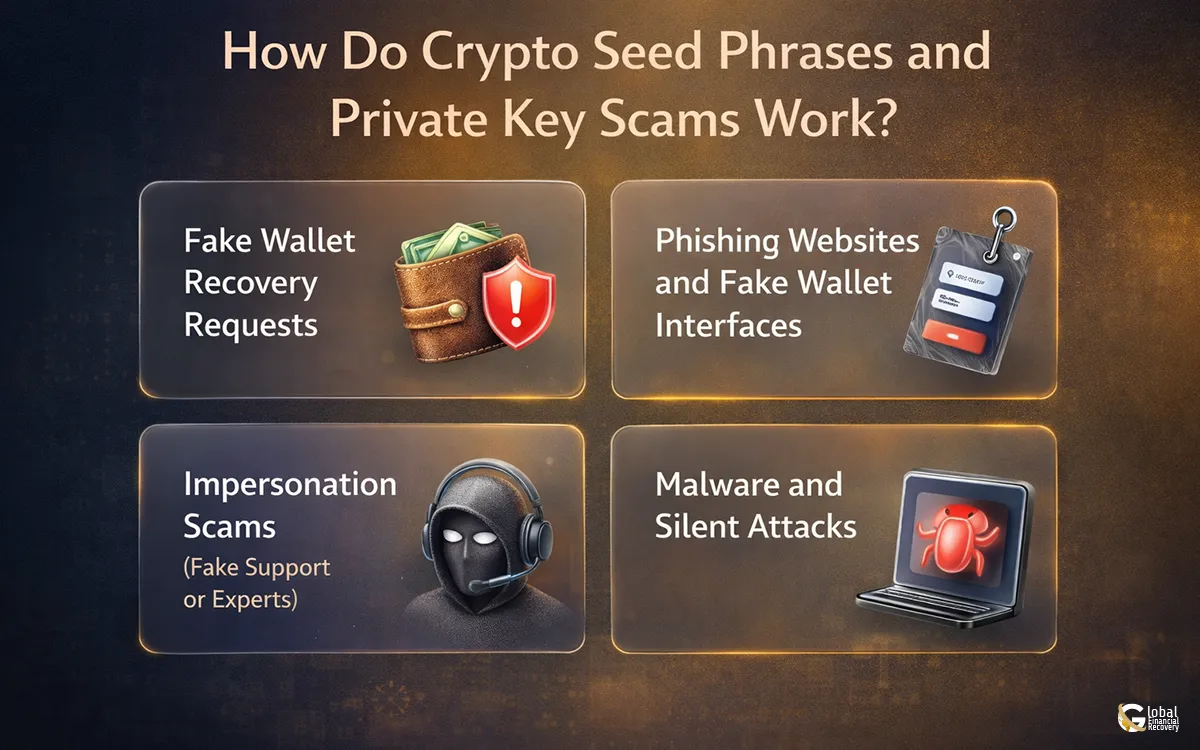
How Do Crypto Seed Phrases and Private Key Scams Work?
Most of these scams do not rely on advanced hacking. Instead, they rely on something much simpler, i.e., getting you to trust the wrong source at the wrong time. Once the scammer builds that trust, the rest becomes easy.
-
Fake Wallet Recovery Requests
One of the most common tactics is offering help when you are already facing a problem. You may come across a website or receive a message claiming they can recover lost funds or fix a wallet issue. It often feels like a solution when you need it the most.
To proceed, you are asked to enter your seed phrase as part of the “recovery process.” It may look like a normal step, but in reality, this is how access is taken. The moment you share those details, your wallet is no longer under your control.
-
Phishing Websites and Fake Wallet Interfaces
Another common method is redirecting you to a fake website that looks almost identical to a real wallet or crypto platform. Everything from the design to the login page feels familiar, which makes it easy to trust.
These websites usually ask you to “verify” or “restore” your wallet by entering your seed phrase. Many users do not realize the risk because the platform looks genuine, which makes it easy to trust what you see.
That is why it becomes important toverify a crypto wallet before sending funds or connecting it, especially when you are dealing with a platform you have not used before. Taking a few extra seconds to check can make a big difference in avoiding these traps.
-
Impersonation Scams (Fake Support or Experts)
Scammers also exploit social platforms by posing as customer support teams, crypto experts, or even well-known influencers. They may contact you directly or respond to your queries in public forums, offering assistance.
The conversation usually feels real. They may guide you step by step and build trust before asking for your seed phrase to “resolve” the issue. In many cases, people only realize what has happened after it is too late.
This is a common pattern in impersonation scams in crypto, where attackers rely on trust and urgency rather than technical hacking to gain access to your wallet.
-
Malware and Silent Attacks
Some scams operate quietly in the background, using malicious apps, downloads, or browser extensions without requiring direct communication.
These tools can capture what you type, record your screen, or even replace wallet addresses when you copy and paste them.
In such cases, you may never knowingly share your seed phrase, but your private information can still be exposed. This makes it even more important to be careful about what you install and where you interact online.
No matter which method is used, the end goal is always the same: to gain access to your seed phrase or private key. Once that happens, the scammer does not need to bypass any security. They already have full control of your wallet.
What Happens If Someone Gets Your Seed Phrase or Private Key?
Once someone has your seed phrase or private key, they do not need to hack anything. They already have full access to your wallet. They can open it on their device, view your funds, and transfer everything without your permission. From that moment, control is no longer in your hands.
This usually happens very quickly. Most scammers act within minutes to avoid giving you time to react. They move funds across multiple wallets to make tracking harder, and by the time you notice, the wallet is already empty. Since crypto transactions are irreversible, there is no way to cancel or reverse them.
Here’s what typically happens next:
- Your wallet is accessed from another device
- Funds are transferred out almost instantly
- Transactions are split and moved across wallets
- There is no option to reverse the transfer
- Any new funds added later can also be stolen
This is what makes these scams so damaging. It is not just about losing money; it is about losing control completely. And once that access is shared, there is no way to take it back.
Common Warning Signs of Seed Phrase and Private Key Scams
These scams often look convincing at first, but they leave behind small clues. If you know what to check for, you can stop before any damage is done. Use this as a quick checklist whenever you are about to connect your wallet or share any information:
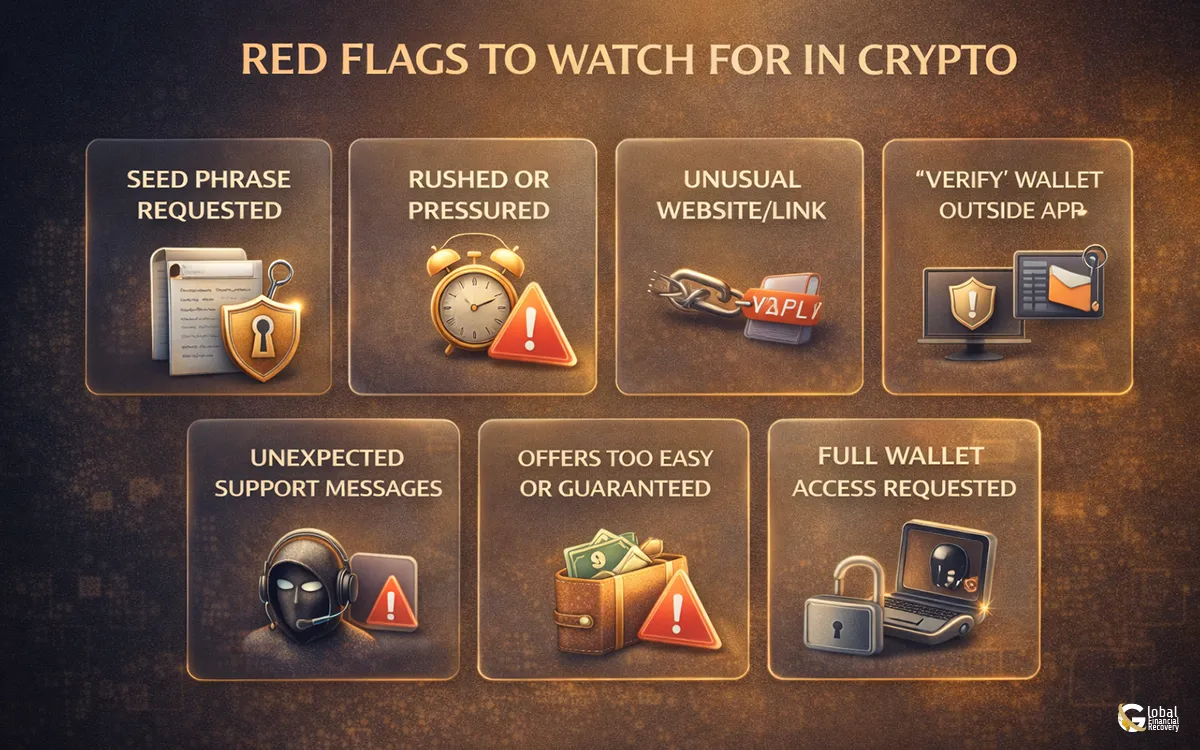
Red Flags to Watch For
- Someone asks for your seed phrase or private key
This is the biggest warning sign. No legitimate service will ever ask for it. - You feel rushed or pressured to act quickly
Messages like “act now,” “your funds are at risk,” or “limited time” are designed to make you panic. - The website or link looks slightly unusual
Small changes in the URL, spelling errors, or different layouts can indicate a fake platform. - You are asked to “verify” or “restore” your wallet outside the official app
This is a common trick used in phishing scams. - Unexpected messages from support or crypto experts
Especially if they reach out first and offer help without you asking. - Offers that sound too easy or guaranteed
Quick profits, instant recovery, or “risk-free” opportunities are often traps. - Apps or tools asking for full wallet access or permissions
Always question why that level of access is needed.
If you notice even one of these signs, it is worth stopping and checking again. Most scams succeed not because they are perfect, but because they catch people off guard.
How Are These Scams Connected to Other Crypto Frauds?
Seed phrase and private key scams rarely happen on their own. In many cases, they are part of a larger setup. What looks like one simple mistake is often the final step in a chain of different scams working together.
For example, you might first come across a fake crypto wallet that looks real and works normally at the start. Over time, it may ask you to “secure” or "recover" your wallet by entering your seed phrase. This is how fake wallet scams are designed to build trust first, then take control.
In other cases, users get trapped in withdrawal fee scams, where they are told to pay extra fees to unlock their funds. When the issue continues, they are eventually asked for wallet access details as a “final step” to process the withdrawal. This is where the actual theft happens.
Similarly, DeFi and wallet-based scams often involve connecting your wallet to a platform that seems legitimate. Once connected, you may be prompted to approve actions or share sensitive information, not realizing that it gives attackers control behind the scenes.
What ties all these scams together is a single goal: getting access to your wallet. Whether it starts with a fake platform, a payment request, or a support message, many scams eventually lead to the same point: asking for your seed phrase or private key.
Understanding this connection helps you see the bigger picture. It is not just about avoiding one type of scam; it is about recognizing the pattern behind them.
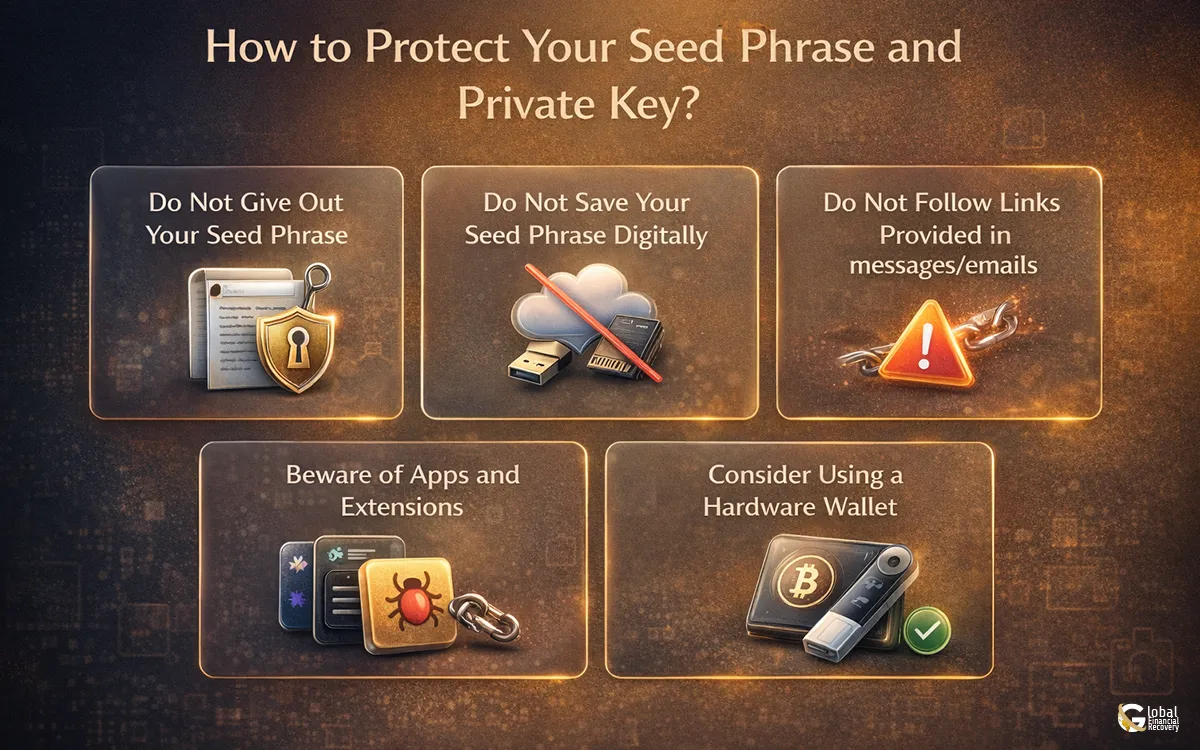
How to Protect Your Seed Phrase and Private Key?
There is no need to be a crypto expert to protect yourself and your funds from various threats; however, there is a need for certain consistency when working with your crypto wallet. In other words, the way you will interact with your wallet seed phrase and private key will decide whether you manage to avoid potential troubles and losses or not.
-
Do Not Give Out Your Seed Phrase
First and foremost, you should understand that no reputable provider of crypto services would even think of requesting your seed phrase and private key. In case you face such an initiative, it can be considered only a scam attempt.
Giving your seed phrase out just once is enough to lose all your funds forever, since you give away total control over your cryptocurrency wallet and all of its resources.
-
Do Not Save Your Seed Phrase Digitally
While digital storage may be easier and faster, it significantly increases the risk of exposing your seed phrase to some kind of attack, malware, or application.
The best solution in terms of seed phrase storing involves writing it down and keeping it offline, since there will be less chance of exposing it to any danger.
There are several fraudsters who use fake websites in order to gather all the information about the users. Spending a little more time verifying the authenticity of the platform can actually save you from major losses.
-
Do Not Follow Links Provided in messages/emails
Sometimes messages or emails containing links can redirect you to a website that may seem legitimate but is actually used by scammers.
It is highly advisable to visit websites directly rather than following the links provided in any message or email.
-
Beware of Apps and Extensions
Certain apps and browser extensions ask for total access to your wallet. Ask yourself why this much access is required, and only install those from reputable sources.
Installing an application may unknowingly give away your personal data.
-
Consider Using a Hardware Wallet
A hardware wallet is a more secure option if you have a lot of crypto. Your keys remain offline, reducing the risk of any attacks via the internet.
Wallet protection does not require a single action but consists of several easy measures. Taking precautions at the right moment can save you from a potentially irreversible mistake.
Protecting your wallet is not about doing one big thing it is about following simple steps consistently. A little caution at the right time can prevent a permanent loss.
Can You Recover Crypto After a Seed Phrase Scam?
In the event that your seed phrase/private key has been compromised, recovering the wallet is highly unlikely. This is because the funds are moved almost immediately after the theft, and since crypto payments are irreversible, you cannot reclaim any money through the same payment channel.
Recovery, however, is not impossible, although this will largely depend on what the thief does after the robbery. Even though you cannot undo the transaction, each of those transactions can be traced on the blockchain ledger. In certain scenarios, tracking these transactions allows you to analyze where the money ends up going and how it is being laundered.
Here is what this means in practical terms:
- You cannot cancel or reverse the transaction
- The stolen funds may still be traceable
- Quick action can help preserve useful transaction data
- In some cases, tracing can support further investigation or recovery efforts
This is where professional help can make a difference. Firms like Global Financial Recovery work with victims to analyze transactions, trace stolen funds, and provide clarity on what options may still be available. The goal is not to make unrealistic promises but to help you understand your situation and take informed next steps.
If you are dealing with a situation like this, the most important thing is not to delay. Even if recovery is uncertain, understanding what happened and securing any remaining assets can help prevent further loss.
Protecting Your Crypto Starts With What You Know
In cryptocurrency, your safety doesn't depend on any bank or platform but on yourself. A seed phrase and private key are not just some technical terms, but the only means of accessing and controlling your funds. If this information is revealed, your control over funds disappears in a few seconds.
The majority of such fraudulent schemes don't use complex hacks. They operate using brief opportunities, links you click on, messages you believe, or even your haste. This is where awareness comes into play. A couple of seconds of thought, a careful review of a potential action, and safeguarding your access rights can mean everything.
People often discover how dangerous these schemes can be when the damage is done. It is important to recognize what happened to prevent the repetition of similar situations in the future.
For those who would like to gain more knowledge regarding their case or look for further actions to take, we at Global Financial Recovery offer our help in transaction analysis. The focus is on helping you get clarity and move forward with the right information.
FAQs (Frequently Asked Questions)
Act as quickly as possible. Move any remaining funds to a new wallet that has a completely different seed phrase. Stop using the compromised wallet right away. After that, review recent transactions to understand what has already been taken and secure all related accounts or devices.
Unrecognized transactions, missing funds, or login activity from unknown devices are common signs. In some cases, you may also notice repeated attempts to move funds. Even small or test transactions can indicate that someone else has access.
Yes, it is possible. Wallet access can be compromised through phishing links, malicious smart contract approvals, or harmful apps and extensions. This is why you should be careful with your seed phrase and how you connect your wallet.
The safest method is to write it down and store it in a secure physical location, such as a locked drawer or safe. Avoid saving it digitally on your phone, email, or cloud storage. Some users also keep multiple copies in separate secure locations to reduce risk.
Always check the website URL carefully, avoid clicking links from messages or emails, and access platforms directly through official sources. Look for small differences in spelling or layout, and take a moment to confirm authenticity before entering any details or connecting your wallet.
Book A Free Consultation
Recent Posts





From case evaluation to financial investigation, Global Financial Recovery provides transparent guidance to help you understand your case and explore your options.