
How Scammers Use Advance Fee Scams to Trick You Into Paying First?
- Cryptocurrency
- Updated On: September 15, 2026
Table of Contents
Advance-fee scams occur when someone asks you to pay money before providing a promised benefit, such as a loan, prize, job, inheritance, investment return, or access to funds. The payment may be described as a processing fee, tax, verification charge, insurance payment, release fee, or another legitimate-sounding expense.
An upfront payment alone does not prove that something is a scam. The risk becomes much greater when the payment is unexpected, the person or organization cannot be independently verified, the promised benefit is unusually attractive, or you are pressured to pay quickly.
This guide explains how advance-fee scams work, the forms they can take, the warning signs to look for, and what to do if you have already sent money.
Important: This article provides general information about common fraud patterns. It is not legal, financial, tax, or law-enforcement advice. Scam circumstances vary, so verify claims independently before taking action.
What Is an Advance-Fee Scam?
An advance-fee scam is a type of fraud in which a person is persuaded to pay money before receiving something that has been promised to them.
The promised benefit can take many forms, including:
- a loan or credit
- a job or employment opportunity
- lottery or prize winnings
- an inheritance
- an investment return
- cryptocurrency withdrawals
- a business opportunity
- a shipment or package
- assistance with another financial problem
The requested payment may be described as a processing fee, application fee, tax, insurance charge, verification fee, customs payment, administrative fee, or release charge.
The central warning sign is not simply that money is requested in advance. It is the combination of an unverified promise, an unexpected payment requirement, and pressure or deception surrounding the transaction.
The FBI identifies advance-fee schemes as a form of business and investment fraud in which people are asked to provide money upfront in expectation of a larger return or promised benefit.
How Does an Advance-Fee Scam Work?
Although the stories differ, many advance-fee scams follow a similar sequence.
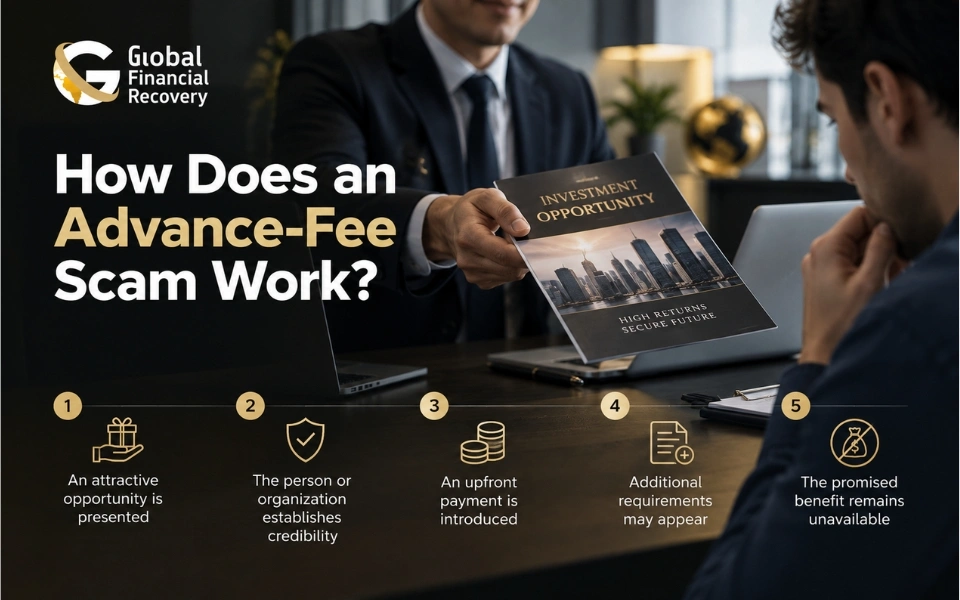
1. An attractive opportunity is presented
The scam may begin with an offer involving a loan, job, investment, prize, inheritance, cryptocurrency account, or another financial benefit.
The offer may appear through email, social media, messaging applications, websites, advertisements, dating platforms, or unsolicited phone calls.
2. The person or organization establishes credibility
Scammers may use company names, logos, documents, contracts, employee identities, certificates, websites, or other materials designed to make the offer appear legitimate.
These materials should not be treated as proof of authenticity on their own. Information should be independently verified using contact details and sources that were not supplied by the person making the offer.
3. An upfront payment is introduced
The requested payment may be presented as necessary to move the transaction forward.
For example, someone might claim that a payment is required for:
- processing
- insurance
- taxes
- verification
- customs
- account activation
- compliance
- liquidity
- withdrawal
- legal or administrative services
The terminology can change, but the underlying request is the same: send money before receiving the promised benefit.
4. Additional requirements may appear
One payment may not end the request. After receiving money, the fraudster may introduce another fee or claim that an additional payment is necessary because of a new requirement. This pattern is particularly important to recognize in investment and cryptocurrency scams.
5. The promised benefit remains unavailable
The promised loan, prize, investment return, inheritance, employment opportunity, or withdrawal may never materialize. The person may continue providing explanations, delay the transaction, request additional payments, or eventually stop responding.
How to Spot an Advance-Fee Scam
An individual warning sign does not necessarily establish that an offer is fraudulent. Look at the overall pattern.
- You’re Asked to Pay Before Receiving What Was Promised
Be cautious if someone asks for a processing fee, tax, verification charge, or release payment before you can receive a loan, prize, investment return, job benefit, or withdrawal. Ask what the payment is for and whether the requirement can be independently verified.
- The Offer Seems Too Good to Be True
Guaranteed loans, unusually high returns, instant approvals, or easy access to money should be treated carefully. Scammers often use attractive promises to make people focus on the reward instead of the risks.
- You’re Pressured to Pay Quickly
Messages such as “Pay today,” “This is your final chance,” or “Your account will be closed” are designed to create urgency. Take your time and verify the claim before making any payment.
- The Person or Company Cannot Be Independently Verified
A professional website, official-looking document, or convincing email does not prove that someone is legitimate. Find the company's contact details independently and verify who you are dealing with.
- The Payment Is Being Sent to an Unrelated Person or Account
Be careful if you are asked to send money to a personal bank account, unfamiliar crypto wallet, or third party that has no clear connection to the company or transaction. Always verify where your money is going.
- New Fees Keep Appearing
One of the most important warning signs is when every payment leads to another requirement. A verification fee may be followed by a tax, compliance charge, or release fee, while the promised money remains unavailable.
- The Documents or Claims Cannot Be Verified
Scammers can create convincing contracts, certificates, invoices, and account statements. Also, do not rely on documents alone. Verify important information directly with the relevant company, authority, or institution.
7 Common Types of Advance-Fee Scams
Advance-fee fraud can be adapted to many situations. The following examples illustrate common patterns.
|
Scam type |
What is promised |
Common payment explanation |
Warning signs |
|
Loan scams |
Guaranteed or easy-to-obtain credit |
Processing, insurance, or application fee |
Guaranteed approval or payment demanded before the promised loan |
|
Job scams |
Employment or overseas placement |
Registration, training, document, or visa fee |
Unexpected payment required before legitimate employment is established |
|
Prize and lottery scams |
Prize or winnings |
Tax, shipping, or processing charge |
You are told you won a prize you never entered |
|
Inheritance scams |
Inherited money or assets |
Legal, transfer, tax, or administrative fee |
Unexpected inheritance and unverifiable representatives |
|
Help with an emergency or shipment |
Medical, travel, customs, or delivery charge |
Repeated emergencies and requests for money |
|
|
Access to displayed cryptocurrency or investment funds |
Tax, verification, liquidity, compliance, or release fee |
Repeated payments required before a withdrawal can occur |
|
|
High returns or release of profits |
Regulatory, tax, account, or profit-release fee |
Guaranteed returns, unverifiable platforms, or demands for more money |
The same fraud may involve more than one category. For example, an investment scam can later become a cryptocurrency withdrawal scam when the victim attempts to access the balance shown on a fraudulent platform.
Cryptocurrency and Withdrawal Fee Scams
Cryptocurrency-related advance-fee scams can be particularly difficult to identify because victims may see an account balance or investment return displayed through an online platform.
A fraudulent platform may allow deposits and show apparent profits while preventing withdrawals. When the user attempts to withdraw, the operator may claim that another payment is required for taxes, compliance, wallet verification, liquidity, account activation, or another reason.
A repeated demand for additional money should be treated as a significant warning sign, particularly when the requirement cannot be independently verified.
The FBI has specifically warned about cryptocurrency investment fraud in which victims are told that they must pay additional money or fees to unlock funds. It also warns that people who have already lost money may subsequently be targeted by recovery scams.
Is Every Upfront Fee a Scam?
No, legitimate businesses can charge fees before providing a service. For example, an organization may legitimately require an application fee, deposit, professional retainer, subscription payment, or other charge.
The presence of an upfront payment should therefore be evaluated in context.
Questions to ask include:
What am I paying for?
Understand the specific service or assistance we will provide.
Are the fees explained clearly?
Make sure you understand any applicable fees before proceeding.
Who is providing the service?
Verify Global Financial Recovery and the team responsible for reviewing your case.
Can I verify the information provided?
Review our website, company information, service details, and available contact information independently.
Does the payment information match the organization?
Confirm that any payment instructions are officially provided by Global Financial Recovery.
What happens if I choose not to proceed?
You should understand your options without being pressured into making a decision.
Am I being pressured to act immediately?
You should have the opportunity to review the information and decide whether our services are right for your situation.
Are the expected outcomes explained realistically?
We do not believe in guaranteed outcomes. Every case is different, and the available options depend on the circumstances and information involved.
If several warning signs appear together, stop the transaction until the situation has been independently checked.
What to Do Before Sending Money
If you are uncertain about an offer, taking a few minutes to verify the information can prevent a much larger loss.

- Verify the organization independently
Find the organization's official website or regulatory listing yourself rather than relying on a link, phone number, or contact information provided by the person requesting payment.
- Verify the person
Check whether the individual actually works for the organization they claim to represent. If possible, contact the organization through independently sourced contact information.
- Verify the payment requirement
Ask the organization or relevant authority whether the fee exists and whether the stated payment method is legitimate.
- Search for complaints and warnings
Search the organization, website, phone number, email address, cryptocurrency wallet address, or other identifying information together with terms such as "complaint," "fraud," or "scam."
Search results alone are not proof, but they can identify information that warrants further investigation.
- Don't allow urgency to replace verification
A legitimate transaction should not require you to ignore basic verification simply because someone says there is no time. If necessary, pause the transaction.
What to Do If You Already Paid an Advance Fee
If you believe you have paid a scammer, act promptly.
1. Do not send another payment
If the same person claims that another fee is required to release your money, stop before making another payment.
The FBI specifically advises potential victims not to pay additional fees or taxes to withdraw money from a suspected investment scheme.
2. Preserve the evidence
Keep copies of:
- emails
- text messages
- WhatsApp or Telegram conversations
- phone numbers
- website addresses
- screenshots
- invoices
- contracts
- payment instructions
- bank statements
- cryptocurrency wallet addresses
- transaction hashes
- account records
- names and identities used by the person contacting you
Do not delete communications simply because you believe they are fraudulent.
3. Contact the payment provider
Depending on how you paid, contact the relevant bank, card issuer, cryptocurrency exchange, payment service, or other provider as soon as possible.
Ask what options may be available to stop, dispute, or report the transaction.
There is no guarantee that a payment can be reversed, but prompt reporting can be important.
4. Report the fraud
Consider reporting the incident to the appropriate law enforcement or consumer protection authority in your jurisdiction.
For U.S. victims, relevant reporting channels may include the Federal Trade Commission and the FBI's Internet Crime Complaint Center.
5. Secure your accounts
If you share passwords, account credentials, identity documents, or other sensitive information, take appropriate steps to protect the affected accounts. Further, change compromised passwords and enable multi-factor authentication where available.
6. Be careful about recovery offers
People who have already lost money to a scam can become targets for another scam. Someone may contact you claiming they can recover your money for an upfront fee, special tax payment, government connection, legal charge, or other expense.
Do not assume that a recovery offer is legitimate simply because the person knows details about your original scam.
A Real Case Study: When the “Final Fee” Kept Changing and One Fee Leads to Another
At Global Financial Recovery, we reviewed a case involving an individual who had invested money through an online trading platform. Over time, the platform showed that the investment had grown, and the account displayed a balance that the individual believed could be withdrawn.
When they submitted a withdrawal request, they were told that the funds could not be released until a verification fee was paid. The platform explained that this was a standard requirement and assured the individual that the withdrawal would be processed once the payment was completed.
After the fee was paid, the withdrawal still did not go through.
The individual was then informed that a tax-related payment was required before the funds could be released. After questioning this new charge, they received further explanations about account compliance and additional requirements.
By the time the individual contacted Global Financial Recovery, several payments had been requested, but the withdrawal remained unavailable.
During the case review, we examined the communication history, payment records, website information, and available transaction details. One pattern became clear: every payment was presented as the final requirement, but another reason for payment appeared once the previous fee had been sent.
This is why we advise people to pause when a supposed withdrawal or payment keeps getting delayed by new fees. A legitimate fee may sometimes exist, depending on the transaction. However, when the payment requirements keep changing and the promised funds remain inaccessible, the situation should be independently reviewed before sending more money.
Privacy note: Case reviewed by Global Financial Recovery. Certain details have been changed to protect client privacy. The purpose of this example is to share a pattern observed during a case review. Every scam situation is different.
When Should You Consider Professional Assistance?
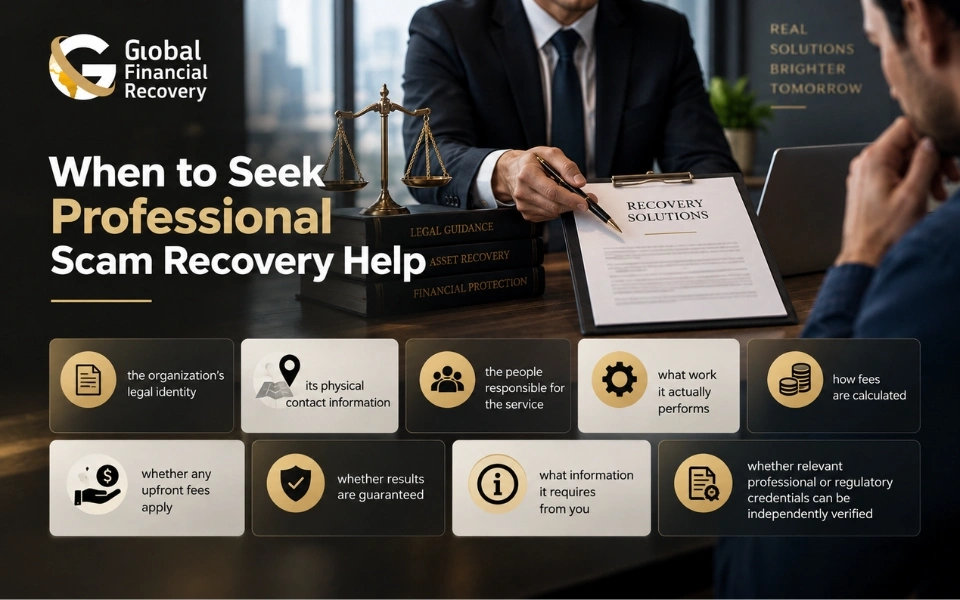
If a financial fraud involves substantial losses, multiple transactions, cryptocurrency transfers, international parties, or extensive digital evidence, you may decide to seek professional assistance.
Before engaging any recovery, investigative, legal, or financial service, verify:
- the organization's legal identity
- its physical contact information
- the people responsible for the service
- what work it actually performs
- how fees are calculated
- whether any upfront fees apply
- whether results are guaranteed
- what information it requires from you
- whether relevant professional or regulatory credentials can be independently verified
Be especially cautious of anyone promising guaranteed recovery. Moreover, a professional service should be transparent about what it can and cannot do.
Stay Alert Before You Pay
Advance-fee scams rely on more than just a request for money. They often combine a convincing promise, a sense of urgency, and a payment requirement designed to make you act before you have time to verify the situation. In many cases, the biggest warning sign is not the first fee itself but what happens after you pay-new requirements appear, the explanation changes, and the promised money or benefit remains out of reach.
If you suspect you have encountered an advance-fee scam, pause before sending another payment. Preserve your messages, payment records, account details, and any documents you received. These details can help establish a clearer picture of how the scam unfolded and what steps may be available next.
At Global Financial Recovery, we understand that every scam situation is different. Our team can help you review the available information, organize the relevant evidence, and better understand your situation and possible next steps.
Think you may have been targeted by an advance-fee scam? Contact Global Financial Recovery to discuss your case and get clarity on what to do next.
FAQs (Frequently Asked Questions)
It could be. An upfront fee does not automatically prove fraud, but you should verify why the fee is required, who is requesting it, whether the organization is legitimate, and where the payment is going before sending money.
Repeated payment requests can be a major warning sign. A scammer may introduce new taxes, verification fees, processing charges, security deposits, or release fees after receiving the first payment.
A legitimate cryptocurrency transaction can involve fees. However, if you are repeatedly asked to pay additional money to unlock, release, verify, or withdraw your cryptocurrency, you should treat the situation as suspicious and independently verify the requirement before paying more.
You should stop sending money, save all evidence, and contact my bank, payment provider, or cryptocurrency platform as soon as possible. You should also report the suspected fraud to the appropriate authorities.
Possibly, but there is no guaranteed way to recover the money. The outcome can depend on the payment method, timing, transaction records, available evidence, and other circumstances. You should be cautious of anyone promising guaranteed recovery.
Book A Free Consultation
Recent Posts




From case evaluation to financial investigation, Global Financial Recovery provides transparent guidance to help you understand your case and explore your options.