
AI Girlfriend and AI Boyfriend Scams: The New Face of Romance Fraud

- Romance
- Updated On: September 10, 2026
Table of Contents
Meeting someone online can quickly become part of your daily life. A few messages can turn into long conversations, calls, shared photos, and talks about the future. But what happens when the person behind that connection is using AI to create the image of a perfect AI girlfriend or AI boyfriend?
AI girlfriend scams and AI boyfriend scams use technology to make fake romantic identities more convincing. Scammers can create realistic photos, write personal messages, clone voices, and even produce fake videos. They may use these tools alongside familiar romance-scam tactics, spending time building trust before bringing up money, investments, or other financial requests.
The Federal Trade Commission reported that nearly 60% of people who said they lost money to a romance scam in 2025 were first contacted through social media, with $298 million in reported losses from these scams. AI adds another layer to the problem by making a fake person and their interactions harder to question.
So, how can you tell whether an online connection is genuine? This guide breaks down how AI romance scams work, the warning signs that set them apart from real relationships, and how these schemes can lead to emotional heartbreak, financial loss, or cryptocurrency theft. Understanding how these scams operate is the best defense against them.
What Makes an AI Romance Scam Different?
An AI romance scam is not completely different from a traditional online romance scam. The scammers still create a fake identity, build a relationship, and finally, through trust, try to get money or sensitive information from their victim.
The difference is how easily scammers can create and maintain that fake identity. AI can help generate realistic profile photos, write natural-sounding messages, create fake social media content, and even produce voice recordings or videos that appear to belong to the person you are talking to.
This makes it even more difficult to spot an AI girlfriend scam or AI boyfriend scam initially. A scammer does not have to depend on a badly written profile or unconvincing message anymore. AI can help them create a very believable individual, story, and conversation.
An AI scam can be made up of several fake identities. For instance, a scammer can create a profile on a dating application that seems genuine, then transfer the conversation to another website or medium, and use AI-generated material to further the scam.
How AI Is Used to Build a Fake Relationship
AI helps scammers create believable identities and maintain relationships with less effort. It can be used at different stages, but the goal is to make the fake relationship feel real.

1. Creating a Convincing Online Identity
AI can help scammers create realistic photos, write believable biographies, and build detailed social media profiles. They may invent a job, family background, hobbies, location, and personal history to appear genuine. This carefully created identity can make an AI romance scam harder to recognize during the early stages of an online relationship.
2. Starting Natural-Looking Conversations
AI can help scammers write friendly and personalized messages that sound natural. They can use details shared during conversations to create relevant replies, ask questions, and keep discussions going throughout the day. This constant communication can make an AI dating scam feel like a normal connection rather than a carefully planned attempt to gain someone's trust.
3. Building Emotional Trust
As conversations continue, scammers can use AI to keep track of personal details and create responses that sound caring and understanding. They may remember important dates, family problems, interests, or relationship concerns. Over time, this attention can create strong emotional trust and make an AI romance scam much harder to recognize.
4. Adding Photos, Voices, or Videos
Scammers may use AI-generated images, cloned voices, or manipulated videos to make their fake identity appear more believable. They may send photos during conversations, make voice calls, or even appear on video. These tools can make an AI dating scam seem more convincing, but seeing or hearing someone online does not confirm their identity.
5. Introducing Money or Financial Requests
Once trust has been established, the scammer may introduce a reason to send money. Common stories can involve an emergency, medical expense, travel problem, investment opportunity, or cryptocurrency payment. In many cases, an AI romance scam becomes financially damaging at this stage, especially when emotional pressure is used to encourage repeated payments.
6. Keeping the Relationship Going
After receiving money, scammers may continue using AI to create messages, photos, voice recordings, or explanations that keep the relationship alive. They may provide new reasons for delays or request additional payments. This can make an AI dating scam continue for weeks or months, leaving the person emotionally attached while their financial losses grow.
Some AI companion scams can follow a similar pattern, with AI-generated interactions creating the impression of an attentive romantic partner who is always available.
AI does not replace the manipulation behind a romance scam. It makes it easier to create the identity, maintain communication, and keep the story consistent.
Why These Scams Can Feel So Real
The strongest part of an AI romance scam is often not the technology. It is the feeling of being understood by someone who seems to care.
An AI girlfriend scam or AI boyfriend scam can involve daily messages, personal conversations, birthday wishes, emotional support, and talking about a future together. AI can help make those interactions more consistent by creating personalized messages, photos, voices, or videos that reinforce the fake identity.
Over time, the person can become part of your routine. Once that emotional connection is there, small inconsistencies may be easier to dismiss, especially when you want to believe the relationship is real. That is what makes these scams so difficult to spot: the technology creates the illusion, but trust keeps it going.
Warning Signs of an AI Romance Scam
An AI romance scam may not come with one obvious red flag. Instead, several details can start to feel unusual as the relationship develops.
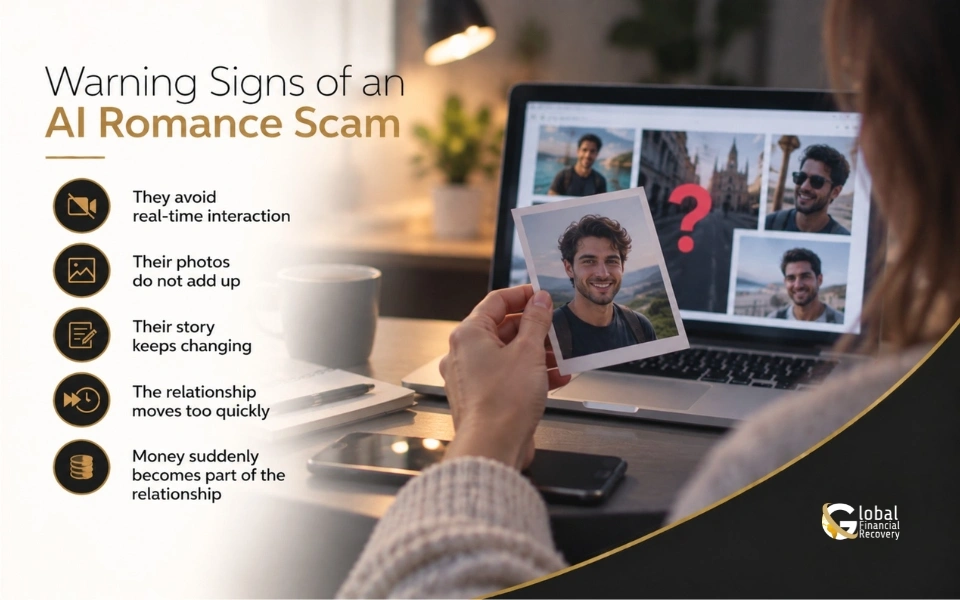
Common warning signs include:
- They avoid real-time interaction: They regularly have excuses for avoiding video calls, live conversations, or meeting in person.
- Their photos do not add up: Images may contain unusual details, inconsistent backgrounds, or facial features that change between photos. A reverse image search can help check where their photos appear online.
- Their story keeps changing: Details about their job, location, family, or personal life do not remain consistent across conversations.
- The relationship moves too quickly: An AI girlfriend scam or AI boyfriend scam may involve intense attention, declarations of love, or talk about a future together before you have had enough time to know the person.
- Money suddenly becomes part of the relationship: They ask for financial help after building an emotional connection.
The money request may be presented as:
- An emergency: Medical treatment, travel, rent, or another urgent expense.
- A personal favor: They claim they cannot access their bank account or need help receiving or sending money.
- An investment: They introduce an opportunity that supposedly helped them make money.
- A cryptocurrency payment: They ask you to buy, send, or transfer cryptocurrency.
- A fee or tax: They claim money is waiting to be released but requires an upfront payment.
These requests can be especially difficult to question when you have already become emotionally attached. Some scams continue after the first payment, with a new emergency, fee, or investment opportunity appearing later.
One sign alone does not prove that someone is running a romance scam. But when several appear together, especially when money enters the relationship, slow things down, verify the person independently, and avoid sending another payment.
How to Check Whether Someone You Met Online Is Real
A video call can show that there is a real person on the other side of the screen. It does not necessarily prove that they are the person shown in their dating profile. The better question is: Do the person, their photos, and their story all match?

Here are some ways to check.
Look for the Same Person Across Different Photos
AI-generated images can look realistic, while stolen photos can belong to someone else entirely. Look at several photos from the person's profile and compare details such as facial features, hair, tattoos, glasses, and other identifying characteristics.
AI-generated images may also contain subtle inconsistencies, such as unusual hands, jewelry, teeth, backgrounds, or facial details. These signs are not proof on their own, but they can justify taking a closer look.
Run a Reverse Image Search
Upload their profile photos to a reverse image search tool and check whether the same images appear under different names, on unrelated social media accounts, or on stock-photo and modeling websites.
Finding the exact photo connected to another person's name is a much stronger warning sign than simply noticing that an image looks polished or unusual.
Check Whether Their Online Identity Matches
Search the person's name, username, workplace, location, or other details they have shared. Look for independent information that supports their story.
A genuine person should generally have some history that makes sense. That does not mean everyone needs a large social media presence, but major differences between what they tell you and what you find are worth questioning.
Use Video Calls to Confirm More Than Their Face
A live video call is useful, but do not treat it as final proof of identity. Pay attention to whether the person can have a natural conversation, answer questions about details they previously shared, and respond normally to the surroundings.
You can also ask them to do something spontaneous during the call, such as wave, turn their head, or hold up a specific object. This is not a foolproof test for AI manipulation, but it can make a prerecorded or heavily manipulated interaction harder to maintain.
Compare Their Story With What You See
Look at the relationship as a whole. Does their location match what they have told you? Do their job, travel plans, family details, and daily routine make sense together?
One unusual detail does not automatically mean someone is fake. A pattern of contradictions is much more concerning.
Verify Important Claims Independently
Do not rely only on information, websites, documents, or links provided by the person. A scammer may create supporting material to make their identity or financial story appear legitimate.
Most importantly, remember that a real person can still be using a fake identity. Someone appearing on a live video call does not prove that the photos, name, job, location, or personal story belong to them.
A Real Example: When Even a Video Call Was Not Proof
One recent case shows just how convincing an AI-powered romance scam can become.
In July 2026, AFP reported on a woman identified as Maria who believed she was in a romantic relationship with someone claiming to be Sheikh Hamdan bin Mohammed bin Rashid Al-Maktoum, the Crown Prince of Dubai. The person contacted her through a dating site before moving the conversation to a messaging app and sending romantic messages.
What made the deception particularly convincing was that the fake suitor did not rely only on photos and text. Maria also received live video calls using AI deepfake technology, making it appear that she was speaking directly with the person she believed she was dating.
Eventually, the relationship turned into a financial request. Reports say Maria transferred 100,000 Philippine pesos, roughly $1,625, which represented her savings for the year.
The case highlights an important lesson for anyone using dating apps or social media: seeing someone's face on a video call does not automatically prove their identity. A scammer may be a real person using someone else's identity, or technology may be used to manipulate what appears on screen.
It also shows why identity checks should not stop at asking, “Can I see you on video?” Photos, usernames, personal details, social profiles, and the person's overall story should all be checked independently before trust turns into financial risk.
What to Do When You Suspect AI Romance Scam
Realizing that someone you trusted may not be who they claimed to be can be upsetting, especially when the relationship has lasted for weeks or months. You do not need to confront the person immediately. Start by protecting yourself and preserving the information that may help you understand what happened.
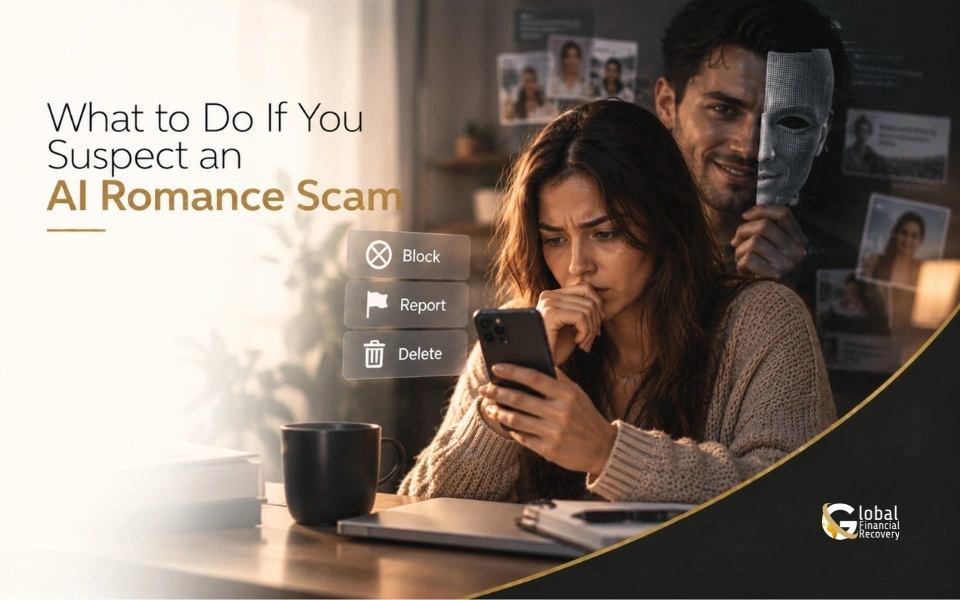
1 Stop Sending Money
Do not send another payment, even when the person promises that it will solve the problem or help you get money back. A new request may simply be another attempt to keep the relationship going.
2 Save Your Conversations and Other Evidence
Keep screenshots of messages, emails, dating profiles, payment requests, phone numbers, usernames, photographs, wallet addresses, and transaction records. Avoid deleting conversations before you have saved copies.
3 Protect Your Accounts
Change passwords that you may have shared and enable multi-factor authentication where available. Contact your bank, card provider, payment service, or cryptocurrency platform promptly when money or account information has been involved.
4 Report the Account
Report the dating profile and any related social media or messaging accounts to the platform. Reporting can help prevent the same identity from being used to target other people.
5 Be Careful With Anyone Promising to Get Your Money Back
After losing money, people are often contacted by someone claiming they can recover it quickly.
for an upfront fee. Treat these approaches with caution. A request for additional payment does not prove that a recovery service is legitimate.
When money has already been lost, the next step is understanding what happened and what options may exist. This is where documenting the full timeline becomes important. Global Financial Recovery, for example, reviews romance scam cases by looking at the available evidence and transaction details before discussing potential recovery options. The important part is to understand what can actually be investigated rather than assuming that every lost payment can be recovered.
Whether you seek professional assistance or handle the initial reporting yourself, keep your evidence organized. The messages, payment records, account details, and timeline you preserve can be some of the most useful information when assessing what happened.
Staying Careful With AI Romance Scams
AI has changed how easily a fake person can be created online. Realistic photos, natural conversations, cloned voices, and convincing videos can make an AI girlfriend scam or AI boyfriend scam look nothing like the romance scams people were used to seeing.
But a convincing profile is still just a profile. What matters is whether the person behind it is who they claim to be. Take time to verify their identity, pay attention to inconsistencies, and be especially careful when a romantic relationship starts involving money, investments, cryptocurrency, or urgent requests for help.
And when you realize you have been scammed, try not to let embarrassment keep you from acting. Save the conversations, profile details, payment records, transaction information, and anything else connected to the relationship. The more complete the record, the easier it is to understand how the money moved and what happened along the way.
For those who have already lost money, an outside review can provide a clearer picture of what happened. Global Financial Recovery can review the details of a romance scam, including conversations, payment records, and other evidence connected to the case. The goal is to understand the circumstances and determine whether there are realistic recovery options worth pursuing. You can discuss your case with us; you can reach out to our team for an initial review. There are no guarantees, but knowing where you stand can make the next step a little clearer.
The relationship may have been built on a lie, but that does not mean you have to deal with the aftermath alone.
FAQs (Frequently Asked Questions)
AI romance scams typically begin with a fake online identity. The scammer builds a relationship through regular communication, uses AI to make the identity and conversations more convincing, and may eventually introduce requests involving money, investments, cryptocurrency, or other financial assistance.
Common warning signs include refusing to meet or have live conversations, inconsistent personal details, suspicious or reused photos, rapid declarations of affection, pressure to move conversations off a dating platform, requests for money, and investment or cryptocurrency opportunities introduced through the relationship.
No. A live video call can show that there is a real person on the other side, but it does not prove that they are using their real identity. Someone can appear on camera while using another person's photos, name, background, or personal story.
Look for unusual details such as distorted hands, inconsistent facial features, strange jewelry, unnatural backgrounds, or details that change between images. However, AI-generated images can be difficult to identify by appearance alone. A reverse image search and independent verification can provide stronger evidence.
Pause before sending anything. Do not allow urgency or emotional pressure to make the decision for you. Verify the person's identity independently, save the conversations and payment details, and contact your bank, payment provider, or cryptocurrency platform when relevant.
Stop communicating about further payments, preserve your messages and transaction records, secure your accounts, and report the relevant accounts and payments. For significant losses, documenting the complete timeline can also help when assessing possible romance scam recovery options.
Book A Free Consultation
Recent Posts




From case evaluation to financial investigation, Global Financial Recovery provides transparent guidance to help you understand your case and explore your options.