
AI Voice Cloning and Grandparent Scams: What Every Family Should Know

- Cryptocurrency
- Updated On: August 18, 2026
Table of Contents
Many families don't second-guess the call from a family member. Hearing a familiar voice brings comfort, trust, and a sense of certainty. That is exactly what scammers are beginning to exploit.
Grandparent scams have been around for years, but they are changing. Criminals now use new technologies to make their lies more believable, rather than just by convincing stories or pretending to be a member of the family. AI tools are becoming more popular, and they are becoming harder to spot, even for people who are usually careful.
What makes this especially concerning is that these scams are no longer based only on convincing stories. They are becoming more advanced forms of impersonation scams, where criminals use AI to make a fake call sound much more believable. Instead of relying only on pressure and emotion, they now use technology to gain trust before asking for money or personal information.
Understanding how these scams work is the first step toward stopping them. In this guide, we'll look at how AI is changing grandparent scams, the warning signs families should know, and the practical steps that can help protect the people who matter most.
What Is an AI Voice Cloning Scam?
A familiar voice has always been a sign of trust. As AI technology becomes more advanced, scammers are finding ways to take advantage of that trust.
An AI voice cloning scam is an advanced form of an impersonation scam. Rather than sounding like a member of the family, scammers impersonate an individual using artificial intelligence to create a convincing voice. In many instances, they call it a fake emergency and press the family to act before they can think or verify the emergency.
What makes this scam especially dangerous is that it doesn't rely on technology alone. It relies on trust, emotion, and urgency. When the person's voice sounds familiar, people lower their guard, even if it doesn't feel right.
Grandparent scams are one of the most common examples, but they are not the only ones. Anyone can be impersonated, including parents, siblings, spouses, or close friends. With AI tools increasingly accessible, this social engineering scam could impact nearly any family.
How Grandparent Scams Are Changing With AI
Grandparent scams are certainly not new; over the years, scammers have taken advantage of false emergencies and tales to get people to send money. However, while the intent behind the scam has not changed because of AI, its impact has certainly improved.
Before AI, scammers usually:
- Pretended to be a grandchild or another close family member.
- Relied on emotional stories about an accident, arrest, or medical emergency.
- Pressured people to act quickly before they could verify the situation.
- Counted on fear and confusion to stop families from asking questions.
With the help of AI, they can now:
- Use AI to clone a loved one's voice with just a short audio sample.
- Make emergency calls sound much more believable.
- Build trust faster because the voice sounds familiar.
- Combine voice cloning with other impersonation techniques to make the scam even harder to detect.
The criminals continue to use trust, urgency, and emotions to manipulate decisions. It is for this reason that AI voice cloning is emerging as an increasingly common form of social engineering scams that focus more on manipulating individuals rather than hacking devices.
Similar tactics are also being used in email phishing scams,fake investment group scams, and other AI-powered scams that target trust instead of technology.
How AI Voice Cloning Scams Work Step by Step
Most AI voice cloning scams follow a similar pattern. While the details may change, the goal is always the same: gain your trust, create urgency, and convince you to act before you have time to think.

Step 1: Scammers Find a Voice Sample
The first step is collecting a short recording of the person they want to impersonate. This can come from public social media videos, interviews, podcasts, or even a voice message shared online. In some cases, just a few seconds of clear audio may be enough for AI tools to recreate a person's voice.
Step 2: A Fake Emergency Is Created
Once the voice is ready, scammers build a story designed to create panic. They may claim a loved one has been in an accident, arrested, stranded while travelling, or needs money for an emergency. The story is meant to feel urgent, so there is little time to stop and question it.
Step 3: The Phone Call Creates Pressure
The cloned voice is then used during a phone call to make the situation feel real. Some scammers even add background sounds, another fake caller pretending to be a police officer or lawyer, or poor call quality to make the conversation seem more believable while hiding any signs that the voice has been generated.
Step 4: They Ask for Money Right Away
Once emotions take over, the scam quickly turns to money. The caller may ask for a bank transfer, gift cards,cryptocurrency, or another payment that can be sent immediately. They often insist that the payment must be made at once and ask the family not to tell anyone until the "emergency" is over.
Step 5: The Truth Comes Out Later
Many families only discover the scam after they contact the real family member or speak with someone else who knows the situation. By then, the money has often already been sent, making it much harder to recover.
Real-Life Example: Why Police Are Warning Families About AI Voice Scams
AI voice scams are no longer just a new type of fraud. They are happening to real families across the United States, and police are asking people to be aware before they get a call like this.
In 2025, the Suffolk County Police Department in New York warned residents about scammers using AI to copy the voices of grandchildren and other family members. Police said scammers were taking short voice clips from social media and using AI to make fake emergency calls. The caller would say they had been in a car crash, arrested, or needed help right away. The goal was to make families panic and send money before they could stop and check if the call was real.
The police issued this warning because just one little effort could prevent this kind of fraud from happening. Don’t immediately do something; take the time to call your loved one back with a phone number that you have before making any decisions.
Cases like this show that scammers are changing the way they trick people, but families can change the way they respond. Being aware of these warnings and waiting just a few moments can be very helpful in protecting your loved ones and yourself financially.
Why AI Voice Scams Are So Convincing
AI voice scams don't succeed because people are careless. They succeed because they take advantage of emotions that almost everyone would feel during a family emergency. The table below shows how scammers influence people's decisions and the warning signs that can help families recognise the scam before it's too late.
|
Why People Believe the Call |
Warning Signs to Watch For |
|
The voice sounds familiar. Hearing someone who sounds like a child, grandchild, or another loved one makes the call feel real. |
The caller asks for money right away. A sudden request for money during an emergency should always be verified first. |
|
The situation feels urgent. Scammers create panic by talking about a car crash, an arrest, or another emergency so there is little time to think. |
The caller tells you to keep it a secret. They may ask you not to tell other family members or say that no one else can know. |
|
People want to help their family. Most parents and grandparents will do whatever they can if they believe someone they love is in danger. |
The payment request is unusual. Be cautious if you're asked to send cryptocurrency, buy gift cards, wire money, or hand cash to a stranger. |
|
Stress makes it harder to think clearly. During an emotional phone call, people often focus on helping instead of checking whether the story is true. |
The caller avoids personal questions. Someone using a cloned voice may struggle to answer simple questions that only your family would know. |
|
The story sounds believable. AI makes old impersonation scams feel more convincing by adding a familiar voice to an already believable situation. |
Something doesn't feel right. The story may have missing details, change during the call, or leave you feeling pressured to act immediately. |
These tactics are used in many types of social engineering scams. Whether it's a romance scam, an email phishing scam, or a fake investment group scam, the goal is often the same: build trust, create urgency, and stop people from taking a moment to verify the situation.
How to Protect Your Family From AI Voice Scams
The best time to prepare for an AI voice scam is before anyone gets the call. A few simple conversations today can help your family stay calm and make better decisions if a fake emergency ever happens.
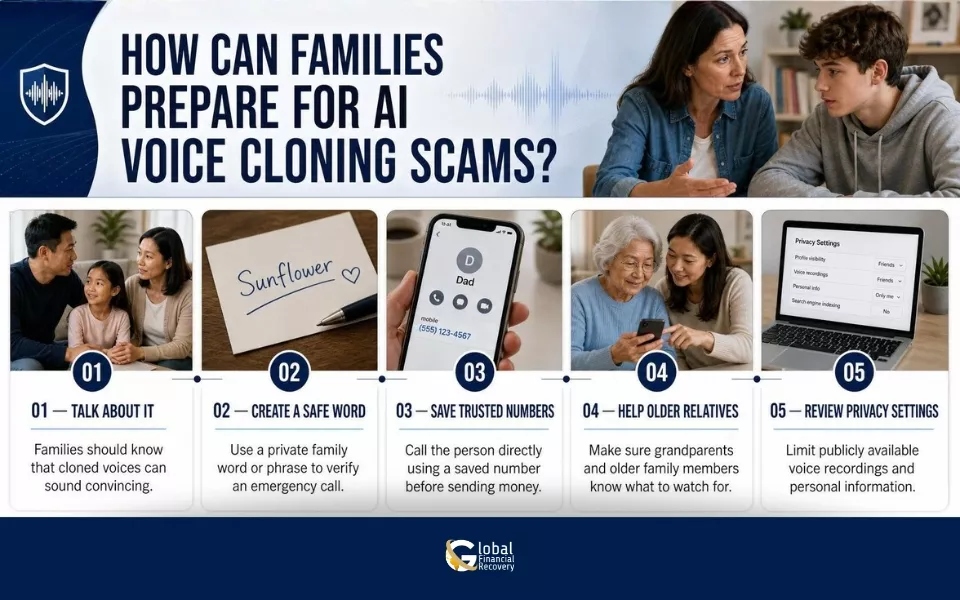
-
Talk About It
Many grandparents have never heard of AI voice scams. A simple family conversation today can help everyone recognise the warning signs before a fake emergency call ever happens.
-
Create a Safe Word
Choose a word or short phrase only your family knows. During an emergency call, ask for the safe word before sending money or sharing personal information.
-
Save Trusted Numbers
Keep phone numbers for close family members in your contacts or written down. If a call feels suspicious, call them back using a number you already trust.
-
Help Older Relatives
Take a few minutes to explain how AI voice cloning works. The more your family understands these scams, the less likely they are to panic during a fake emergency.
-
Review Privacy Settings
Voice recordings shared online can sometimes be used to create AI voice clones. Check your privacy settings and think about what you share publicly.
No family can stop every scam. But staying connected, talking openly, and taking a few simple precautions can make these scams much easier to recognize and much harder for criminals to pull off.
What To Do After Losing Money to an AI Voice Scam
Losing money to an AI voice scam can feel overwhelming, but taking the right steps quickly can make a difference. Here's what to do next:
- Contact your bank or payment provider right away. Ask whether the payment can be stopped, reversed, or reviewed.
- Save everything related to the scam. Keep phone numbers, messages, emails, payment receipts, transaction records, voice recordings, and any other information connected to the call. When cryptocurrency is involved, save wallet addresses and transaction IDs as well.
- Report the scam. Notify your local law enforcement agency and the appropriate fraud reporting authorities. Reporting the incident may also help prevent others from becoming targets.
- Be careful of recovery scams. Some criminals target people who have already lost money by promising guaranteed recovery for an upfront fee. Always research any company before sharing personal information or making another payment.
- Seek professional guidance for complex cases. Every case is different. Whether money can be recovered depends on factors such as the payment method, transaction history, how quickly the incident was reported, and the available supporting evidence.
For cryptocurrency-related cases, professionals like Global Financial Recovery can be of great help. When cryptocurrency is involved, a cryptocurrency scam recovery investigation may use blockchain tracing to review the movement of funds and better understand where the assets were sent.
One Conversation Today Could Prevent a Scam Tomorrow
While AI has altered how scams affect families, it need not alter how your family responds to the scam. A voice may sound genuine enough, but taking just a little more time to check the facts will prevent an artificial emergency from turning into a financial crisis.
Sometimes the answer lies in the simplest of discussions within the family unit. Talking to mom, dad, grandma, grandpa, and any other relatives about voice scams powered by AI can go a long way toward protecting against fraud.
Some families stop the scam before any money is lost. Others only discover the truth after the payment has already been made. When that happens, understanding what happened and knowing the next steps can make a real difference. Global Financial Recovery reviews each case individually, using transaction records, blockchain analysis where applicable, and other available evidence to help people better understand their situation and the recovery options that may be available.
AI can copy a familiar voice, but it cannot replace a real conversation. One quick phone call, one simple question, or one extra moment to verify could be all it takes to protect your family from a scam.
FAQs (Frequently Asked Questions)
Yes. Many AI tools only need a short voice sample to create a convincing voice clone. Public videos, voice messages, podcasts, and interviews can all provide enough audio for scammers to imitate someone's voice. This is why reviewing privacy settings and thinking carefully before sharing voice recordings online has become an important part of online scam prevention.
The fastest way to check is to end the call and contact your loved one using a phone number you already know. A real emergency can always be verified. AI may copy a person's voice, but it cannot confirm the situation or answer personal family questions as naturally as the real person.
Yes. AI voice scams are a type of impersonation scam because criminals pretend to be someone you know and trust. They also fall under social engineering scams because they use fear, urgency, and emotional pressure to influence decisions instead of hacking devices or accounts.
Many scammers ask for payment methods that are difficult to reverse, such as cryptocurrency, gift cards, wire transfers, or cash. These payment methods are commonly used in many forms of online fraud because they can make it harder for victims to recover their money.
It depends on the circumstances of the case. Factors such as the payment method, how quickly the scam was reported, transaction records, and the available supporting evidence all play a role. In cases involving cryptocurrency, blockchain tracing may help review the movement of funds and support the investigation.
Book A Free Consultation
Recent Posts






From case evaluation to financial investigation, Global Financial Recovery provides transparent guidance to help you understand your case and explore your options.